Why You Need The Right ITAD Partner for Government Federal, State, and Local Agencies
Government organizations handle some of the most sensitive data in existence. When IT assets are decommissioned, the data on them doesn’t disappear. FISMA mandates that it does, and the penalties for getting it wrong are severe.
Government Needs the Right ITAD Partner
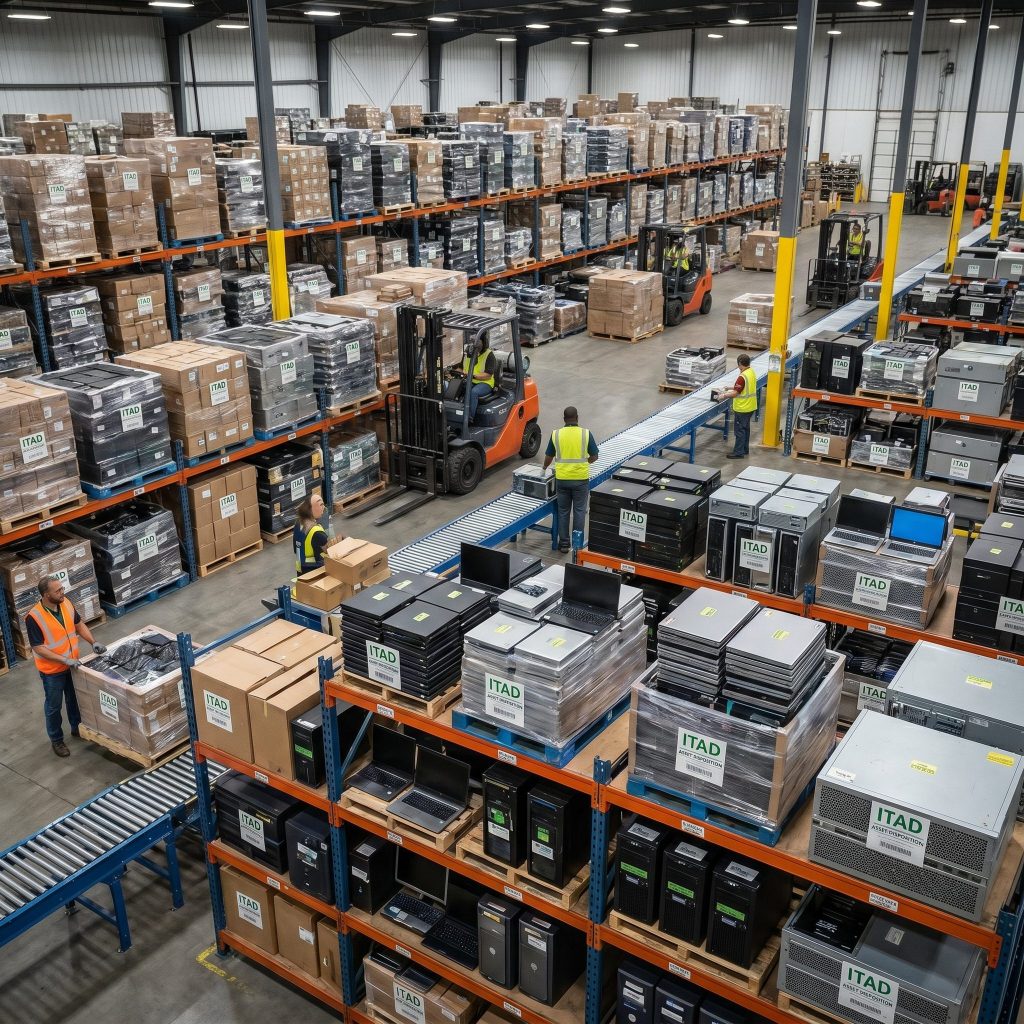
Your agency just refreshed 2,000 endpoints across three regional offices. The new machines are deployed, mission systems are stable, and the old hardware is sitting on pallets in a warehouse waiting on “someone in property management.” Every one of those drives still holds data. Citizen records, case files, internal communications, credentials, configuration data, possibly classified or controlled unclassified information (CUI).
Until those assets are properly sanitized, transported, and documented, your agency is sitting on a FISMA violation waiting to happen. That is what Government ITAD services exist to solve. They are a core part of your security posture, not a back office afterthought, and choosing the wrong vendor can cost you far more than the equipment was ever worth.
Why Is Government ITAD a Bigger Compliance Risk Than Most Agencies Realize?
Here is the thing most agencies miss: the federal standard for data sanitization fundamentally changed in September 2025. NIST released Special Publication 800-88 Revision 2, and it is now the governing reference under FISMA for every federal agency hardware disposal program. The big shift? It moved away from a narrow focus on specific sanitization techniques toward a mandate for establishing a comprehensive, agency wide media sanitization program. Translation: a one off wipe is no longer enough. Auditors now expect a documented, repeatable, agency wide program with proof at every step.
All sanitization techniques and tool details have been replaced with recommendations to comply with IEEE 2883, NSA specifications, or an organizationally approved standard, which means the technical bar got higher too, especially for SSDs and NVMe drives that standard overwrite procedures cannot adequately sanitize. The financial exposure backs up the urgency. According to IBM’s 2025 Cost of a Data Breach Report, U.S. data breaches averaged $10.22 million per incident, more than double the $4.88 million global average. For public sector agencies specifically, breach costs and the reputational damage that follows hit harder because trust is the currency you operate on.
What Exactly Are Government ITAD Services?
ITAD stands for IT Asset Disposition. In plain English, it is the process of retiring your old technology the right way. For government, that means inventorying what you have, securely transporting it, sanitizing or physically destroying the data following NIST SP 800-88 Rev. 2, documenting every step at the serial number level, and either remarketing the hardware for value recovery or recycling it responsibly.
Government ITAD services should add a federal grade chain of custody on top of that. Tamper evident seals, GPS tracked logistics, witnessed destruction options, and certificates of sanitization that map directly to FISMA, FISCAM, and inspector general audit requirements. A vendor that cannot produce that documentation is a liability, not a partner.
What Does NIST 800-88 Rev. 2 Actually Require When You Dispose of Equipment?
This is where agencies get tripped up. NIST does not hand you a single checklist that says “use this tool, fill out this form.” The publication requires covered entities and contractors to implement a program for the final disposition of electronic media and the data it lives on. The accepted technical blueprint for how to do that is the NIST 800-88 Rev. 2 guideline, which spells out three escalating sanitization categories:
Clear, Purge, and Destroy. Sanitization methods must match data sensitivity classification, Clear for low sensitivity, Purge for moderate, and Destroy for high sensitivity federal systems. A defensible Government ITAD program ties each retired asset to its data classification, applies the right method, validates that the sanitization actually worked, and produces evidence that survives an audit. You can review the full guideline directly at the NIST Computer Security Resource Center.
How Do You Build a Government ITAD Program That Survives an Audit?
Start with three pillars: inventory, sanitization, and documentation. Inventory means knowing exactly what assets your agency owns, where they live, and what data classification rides on them. Most agencies are weaker here than they think. Sanitization means matching the right method to the data sensitivity and using tools that comply with NIST SP 800-88 Rev. 2 and IEEE 2883.
Tools like Blancco Drive Eraser generate tamper proof certificates of erasure that map cleanly to federal audit requirements. Documentation is where most programs fall apart. You need serial number level chain of custody from the moment an asset leaves the user’s desk to the moment it is destroyed, recycled, or remarketed. If you cannot produce that paper trail on demand, you do not have a defensible program. You have a hope and a prayer.
What Should You Look for in a Government ITAD Vendor?
Certifications are not optional here. At minimum, your vendor should hold R2v3 (the current responsible recycling standard, not the outdated R2:2013), NAID AAA for data destruction, and ideally ISO 27001 for information security management and ISO 14001 for environmental management.
For federal work specifically, look for vendors that are GSA approved and, where applicable, certified through the Defense Logistics Agency. Ask hard questions before you sign anything. Where does my equipment physically go? Who handles it at every step? Can you provide witnessed destruction? What does your certificate of sanitization actually show? Can you produce a sample audit package? A trustworthy vendor will answer all of that in writing without flinching. You can verify current certifications through the SERI R2 certified facility directory and the NAID AAA certified company directory.
How Do You Prove Data Was Properly Destroyed in a Government Setting?
You prove it with documentation, period. A certificate of sanitization for every drive, tied to its serial number, listing the sanitization method used (Clear, Purge, or Destroy), the standard followed, the operator, the date, and the validation result. For physical destruction, you want a certificate of destruction that includes the same identifying details plus the destruction method (shredding, disintegration, degaussing followed by shredding for magnetic media).
For high sensitivity assets, witnessed destruction with video documentation is the gold standard. Your inspector general or FISMA auditor is going to ask for this evidence at the asset level, not in aggregate. If your vendor can only show you a summary report that says “500 drives destroyed,” you are exposed.
So What Is the Real Risk Most Agencies Are Underestimating in Their Disposal Process?
The real risk is not the cost of the ITAD program. It is the assumption that what worked under the old NIST 800-88 Rev. 1 standard still works today. It does not. Revision 2 raised the bar from “did you wipe the drive” to “can you prove your agency runs a documented, validated, auditable sanitization program that handles modern storage media correctly.” Most agencies are still operating under the old assumptions, still treating disposal as an IT housekeeping task, and still relying on vendors who cannot produce serial number level evidence.
That gap between what auditors now expect and what agencies are actually doing is where the compliance risk lives, and it is bigger than most CIOs and CISOs realize until an inspector general report or a breach notification forces the conversation. The fix is not complicated, but it does require treating Government ITAD as the strategic risk management function it has become. Inventory what you have. Match sanitization to data sensitivity using NIST SP 800-88 Rev. 2. Document everything at the serial number level. Pick a vendor with current certifications and a track record in the public sector. That is the foundation of a defensible Government ITAD program, and everything else builds from there
FISMA & NIST 800-88 Rev. 2 Compliance
Federal Sanitization Standards
Comprehensive guide to the September 2025 NIST SP 800-88 Rev. 2 update, the new program requirements under FISMA, sanitization category mapping (Clear, Purge, Destroy), and serial number level chain of custody documentation that satisfies FISCAM audit requirements.
FISMA Compliance InfoGovernment Data Breach Prevention
Public Sector Risk Management
Cost statistics ($7.42 million U.S. average per IBM 2025), common breach vectors from improper agency disposal, real audit findings from GAO and inspectors general, and why standard wipes no longer satisfy federal requirements for modern storage media.
Government Breach Prevention InfoClassified & CUI Data Destruction
NSA Approved Methods
Specialized destruction protocols for classified and controlled unclassified information, including NSA approved degaussers and disintegrators, witnessed destruction with video documentation, and handling procedures for SSDs, NVMe drives, and embedded flash media.
Classified Destruction InfoCommon risks and violations in government ITAD
These are the most frequent ways government organizations fail to properly dispose of IT assets — and the consequences that follow.
Retired assets stockpiled in warehouses, field offices, or unsecured storage areas.
Old laptops, desktops, servers, and network gear containing citizen records, case files, CUI, and agency credentials are routinely stored in unsecured locations “until property management gets to them.” These devices remain a FISMA liability for as long as they contain recoverable data, whether they are in a regional office or a basement storage cage.
Using factory reset instead of NIST 800-88 Rev. 2 compliant data destruction.
A factory reset does not meet FISMA’s standard for data disposal. Recovery tools can pull citizen records, credentials, and configuration data from devices that staff assumed were wiped clean. Without certified data destruction (Clear, Purge, or Destroy per NIST SP 800-88 Rev. 2), the data is still recoverable. Standard overwrite procedures also fail to adequately sanitize SSDs, NVMe drives, and embedded flash media.
No serial number level chain of custody from desk to destruction.
Most agencies can report that “500 drives were destroyed last quarter.” Far fewer can show, at the serial number level, exactly which drive left which user, who transported it, when it was sanitized, what method was used, and who validated the result. That gap is the single most common finding when an inspector general or FISCAM auditor examines an agency’s disposal program.
Handing equipment to an uncertified vendor or assuming "the contractor handles it."
A vendor without current R2v3, NAID AAA, ISO 27001, and where applicable GSA approval is not a partner, it is unmeasured risk. Agencies that hand off retired hardware without verifying where it physically goes, who touches it, and what documentation comes back are inheriting whatever that vendor does or fails to do, including improper export, downstream resale of unwiped drives, and missing destruction certificates.
How can SureDispose help you?
Most government agencies do not struggle with whether they need an ITAD partner. They struggle with knowing whether the one they picked can actually deliver what FISMA, NIST SP 800-88 Rev. 2, and their inspector general expect. That gap between what vendors promise and what they can prove is where agencies get burned. A wrong choice does not just mean wasted budget. It means unwiped drives leaving your custody, missing certificates of destruction, chain of custody gaps that surface in FISCAM audits, and exposure to breach costs that now average $10.22 million for U.S. organizations. By the time an IG report flags the problem, the damage is already done.
SureDispose is an independent advisory platform, which means we do not perform IT asset disposition services ourselves. We have no equipment to sell you, no warehouse to fill, and no disposal contract to push. What we do is sit on your side of the table before you sign anything. Our assessment maps the specific regulations and standards your agency operates under, including FISMA, NIST SP 800-88 Rev. 2, FISCAM, and where applicable, NSA/CSS requirements for classified and CUI media. We identify the documentation you will need to stay audit ready, define the certification baseline your vendor must meet (R2v3, NAID AAA, ISO 27001, GSA approval), and give you the questions to ask any ITAD provider before a single device leaves your building. From there, we connect you with vetted partners who have been checked against the standards your mission actually demands.
The step before the vendor
How SureDispose works
Three steps to go from uncertainty to a clear, documented action plan.
Assess your compliance exposure
Answer a few questions about your industry, data types, and current practices. Get a clear picture of where you stand.
Understand your regulatory requirements
See exactly which regulations apply to your organization and what they require for IT asset disposition.
Get matched with certified providers
Connect with vetted, certified ITAD providers who meet your specific industry requirements. No obligation.
Ready to assess your ITAD readiness?
Free. Independent. Takes about 5 minutes. No obligation.
Start the Assessment →Government Articles
Government
FedRAMP and ITAD: How Cloud Authorization Boundaries Affect On-Prem Asset Disposition for Federal Agencies
When a federal agency migrates a workload from on-premises infrastructure to a FedRAMP-authorized cloud service, the workload’s data security controls move with it; partly. The cloud service inherits FedRAMP authorization…
Read articleGovernment
GSA Acquisition Vehicles for ITAD: Schedule 36 vs Schedule 70 vs MAS Consolidation
A federal contracting officer looking to procure IT asset disposition in 2018 had to know two schedule numbers. One for IT services (Schedule 70). One for office and document solutions,…
Read articleGovernment
DoD 5220.22-M and Modern Solid-State Storage: Why the 1995 Standard Doesn’t Sanitize SSDs
“Wipe to DoD standard.” It is one of the most persistent phrases in federal and federal-adjacent ITAD procurement, appearing in statements of work and disposition policies that have not been…
Read articleGovernment
NSA EPL Equipment Guide: Approved Degaussers, Disintegrators, and Crushers for Classified Destruction
For classified storage media, equipment procurement is rule-bound. The National Security Agency maintains the Evaluated Products List (EPL) through its Center for Storage Device Sanitization Research (CSDSR), and any device…
Read articleGovernment
NIST 800-88 Rev 2 Implementation for Federal Agencies: What Changed and What Auditors Now Expect
NIST Special Publication 800-88 Revision 2 was published on September 26, 2025, formally superseding Revision 1 after a public comment period that closed August 29, 2025. For federal agencies operating…
Read articleGovernment
ITAD Supply Chain Risk for Government Agencies: Lessons From the 2025 Wisetek/Iron Mountain Incident
In February 2025, the U.S. Attorney’s Office for the District of Columbia announced a guilty plea that should be required reading for every federal contracting officer responsible for IT disposition.…
Read articleFrequently Asked Questions
Everything you need to know about IT asset disposition and how SureDispose can help.
Do you have more questions?
Have more questions? We're here to help with answers, guidance, and clarity for your ITAD needs.
Contact UsThis includes data destruction, asset tracking, certified recycling, and ensuring compliance with environmental and data privacy regulations
No. SureDispose is an independent advisory platform. We assess your compliance exposure, evaluate your readiness, and connect you with vetted, certified ITAD providers that match your specific needs. We never perform disposition services ourselves.