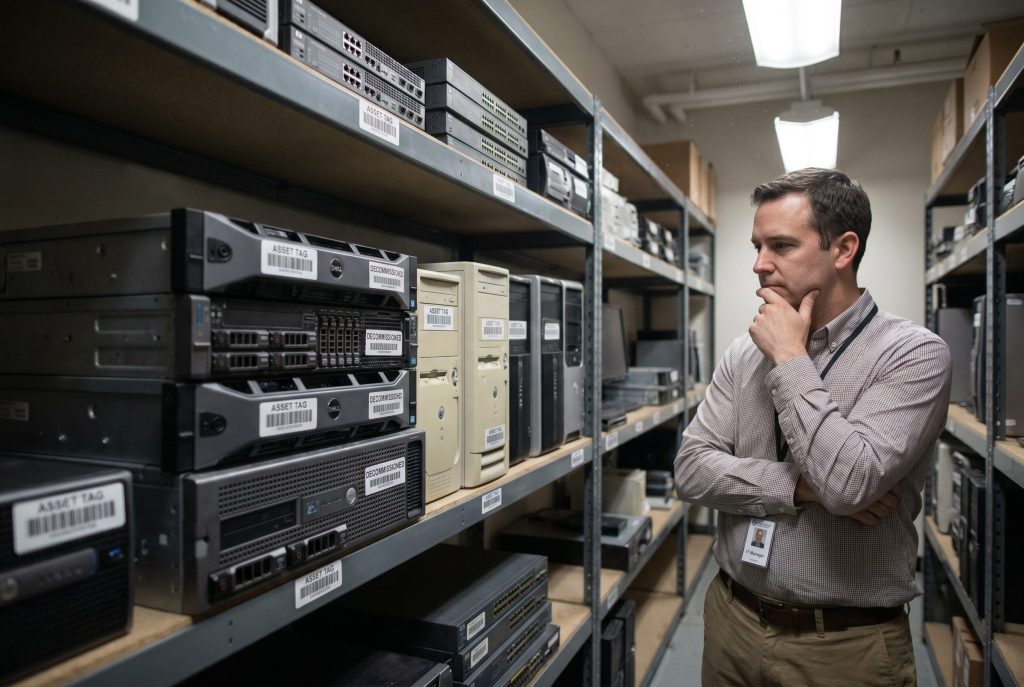
A K-12 district’s IT asset disposition (ITAD) challenge is defined by volume — tens of thousands of identical Chromebooks flowing through a single, standardized process. A university’s challenge is defined by complexity — research computing clusters containing ITAR-controlled defense data, campus workstations with cached student records, medical school equipment subject to HIPAA, and a decentralized governance structure where every college, department, and lab makes its own technology decisions.
No other vertical in the ITAD landscape combines as many device types, regulatory frameworks, data sensitivity levels, and procurement constraints in a single institution. This guide maps the decommissioning landscape for CIOs, IT asset managers, and research computing directors at four-year and research universities.
The University Data Landscape
University IT infrastructure generates and stores data across a wider range of sensitivity levels than any single-sector organization. A university’s device inventory may simultaneously contain student education records protected by FERPA (34 CFR Part 99), federally funded defense research subject to International Traffic in Arms Regulations (ITAR), human subjects research data governed by NIH data sharing policies and IRB protocols, clinical data from university medical centers subject to HIPAA, financial aid records containing student Social Security numbers and tax information, employee HR and payroll data, campus security footage (including video of minors in university-affiliated K-12 programs), and intellectual property including unpatented algorithms, unpublished research, and proprietary software.
This data lives on an equally diverse hardware inventory: high-performance computing (HPC) clusters, GPU arrays, research workstations, classroom desktops, faculty laptops, campus servers, network infrastructure, surveillance systems, library kiosks, and laboratory equipment.
The first challenge of university ITAD is classification: determining which regulatory framework applies to which device, based on the data it contains, before selecting the appropriate sanitization method and documentation standard.
Research Computing: High Value, High Sensitivity
Research computing infrastructure represents the highest-value and highest-sensitivity segment of university ITAD.
GPU Clusters and HPC Infrastructure
Research universities (R1 and R2 classifications) invest millions in GPU clusters, FPGA arrays, and high-performance computing infrastructure for computational research. These systems are refreshed on three-to-five-year cycles driven by performance requirements — researchers need the latest hardware to remain competitive for grants and publications.
The ITAD opportunity is significant: decommissioned GPU clusters, particularly those with recent-generation NVIDIA GPUs, carry substantial remarketing value. A well-managed disposition program can generate meaningful revenue that offsets the cost of the replacement infrastructure.
The ITAD risk is equally significant. Research computing systems may contain unpublished research data representing years of faculty work, proprietary algorithms and machine learning models that constitute institutional intellectual property, datasets from federally funded research with specific retention and destruction requirements, and defense-related research data subject to ITAR export controls.
ITAR Considerations
Universities that conduct defense-funded research — common at R1 institutions with DoD, DARPA, or intelligence community grants — must manage ITAR compliance during hardware disposition. ITAR-controlled technology and technical data cannot be exported, transferred to foreign nationals, or disposed of through channels that could result in foreign access.
For ITAD, this means that devices containing ITAR-controlled research data cannot be remarketed through standard secondary-market channels unless the data has been sanitized to a standard that eliminates any possibility of recovery. Physical destruction is the conservative path. If the university elects to sanitize and remarket, the sanitization must meet NIST 800-88 Rev. 2 Purge standards with verification and validation documented — and the remarketing channel must be restricted to domestic buyers with no foreign access.
University export control offices should be involved in the ITAD process for any equipment that operated in ITAR-controlled research environments. The disposition plan should be reviewed and approved before any hardware leaves the controlled environment.
NIH and NSF Data Requirements
Federally funded research under NIH and NSF grants may carry specific data retention and destruction requirements. Some grants require data to be retained and made available for a specified period after the research concludes. Destroying hardware containing grant-funded datasets before the retention period expires violates the grant terms and can affect the institution’s eligibility for future funding.
Before disposing of research computing equipment, verify with the principal investigator and the Office of Sponsored Programs that all data retention obligations have been met and that the data has been migrated to compliant archival storage.
Not sure where your institution stands? Take the free ITAD Readiness Assessment →
The Decentralized Governance Challenge
University IT governance is fundamentally decentralized. Central IT manages campus infrastructure — the network, the data center, enterprise systems like the SIS and ERP. But individual colleges, departments, and research labs typically manage their own technology procurement, deployment, and — by default — retirement.
This creates three specific problems for ITAD:
Invisible inventory. Central IT may not have visibility into the hardware purchased by individual departments, particularly research equipment funded through grants. A physics department that purchased a GPU cluster through an NSF grant may retire that equipment without central IT’s knowledge — and without any documented disposition process.
Inconsistent practices. Without a university-wide ITAD policy, each department develops its own informal practices. Some may engage certified vendors. Others may donate old equipment to students. Others may simply accumulate hardware in storage rooms indefinitely. The result is a patchwork of practices that range from compliant to dangerously informal.
Split accountability. When a department disposes of equipment improperly and a data exposure results, the university — not the department — bears the regulatory and legal liability. FERPA violations, ITAR breaches, and HIPAA exposures all flow to the institution, regardless of which organizational unit made the disposition decision.
The institutions that manage this well establish a centralized ITAD policy that applies university-wide, with a designated coordinator who has visibility into department-level equipment retirements. The policy doesn’t need to centralize all disposition operations — departments can still manage their own timelines — but it must standardize the vendor qualification requirements, the documentation standards, and the approval process for disposing of devices that contained sensitive data.
Campus Infrastructure and Student Data
Beyond research computing, universities manage a large-scale campus IT infrastructure that generates FERPA-protected student data across multiple touchpoints.
Classroom and lab workstations in shared computing environments cache student login sessions, locally stored coursework, and assessment data. When these workstations are refreshed, the drives must be sanitized to NIST 800-88 Rev. 2 Purge or Destroy standard before leaving the institution.
Faculty and staff workstations may contain unprotected research data, grant proposals, student grade records, recommendation letters, and advising notes — all FERPA-protected when they reference individually identifiable students.
Library kiosks and self-checkout stations cache patron borrowing histories and student ID data. These devices are managed by library IT rather than central IT and are frequently overlooked in disposition planning.
Campus security and surveillance systems contain video footage of students and visitors. For universities with affiliated K-12 programs (lab schools, early childhood centers), this footage includes recordings of minors, which carries heightened privacy considerations.
Student information system (SIS) servers and their backup infrastructure contain the institution’s most complete and sensitive student dataset. Decommissioning a server that hosted your SIS — or a backup drive that replicated it — requires the highest sanitization standard and the most rigorous documentation in your ITAD program.
Not sure where your institution stands? Take the free ITAD Readiness Assessment →
Procurement: Cooperative Purchasing and State Requirements
University ITAD procurement operates under constraints that differ from both K-12 districts and private enterprises.
Cooperative Purchasing Vehicles
Universities can leverage cooperative purchasing agreements to procure ITAD services without a full competitive solicitation. The primary cooperative vehicles for higher education include E&I Cooperative Services (serving over 6,000 member institutions), NASPO ValuePoint (accessible to state university systems), and state-level cooperative purchasing agreements that vary by jurisdiction.
Using an existing cooperative contract can reduce procurement timelines from months to weeks — a meaningful advantage when research computing refreshes create urgent disposition needs.
State Surplus Property Requirements
Public universities are subject to state surplus property rules that mirror the federal hierarchy. For example, Texas state law requires that obsolete university equipment first be offered to other departments within the campus, then to local school districts and charter schools at no charge, then to the Texas Department of Criminal Justice. Only after these state-mandated channels are exhausted can assets be commercially disposed of.
These requirements create the same operational tension as the federal surplus hierarchy: ITAD vendors must support sanitization-for-reuse workflows that remove all sensitive data while preserving hardware functionality for donation recipients. The Certificate of Sanitization for donated equipment must document that FERPA-protected data, research data, and any regulated information was removed to a defensible standard.
Board Approval and Budget Cycles
University procurement often requires board approval for contracts above certain thresholds, and budget cycles may not align with hardware refresh timelines. Building ITAD costs into the original hardware procurement budget — allocating end-of-life disposition funding at the time of purchase — is the most effective way to avoid the situation where equipment reaches end of life with no funded disposition plan.
Value Recovery: The University Advantage
Universities hold one significant advantage in the ITAD value equation: their hardware mix includes high-value equipment that generates meaningful remarketing revenue.
Recent-generation GPUs from research clusters command premium prices on the secondary market. Enterprise servers decommissioned from campus data centers retain value for three to four years after deployment. Apple devices (common among faculty) have consistently strong remarketing returns. Even standard classroom workstations in good cosmetic condition generate modest per-unit returns that aggregate meaningfully across a large fleet.
A well-structured ITAD program can offset a significant portion of disposition costs — and in some cases generate net revenue — through value recovery. The key is engaging a vendor with robust secondary-market channels and transparent revenue-sharing terms, while maintaining the non-negotiable requirement that all data is sanitized before any device enters the remarketing pipeline.
Where You Stand Matters
University IT decommissioning is the most complex ITAD engagement in education — and one of the most complex in any vertical. The combination of research data sensitivity, ITAR and grant compliance obligations, decentralized governance, FERPA requirements on student-facing systems, state surplus property constraints, and high-value hardware creates a disposition challenge that requires both policy sophistication and operational execution.
The institutions that get this right start with a centralized ITAD policy, engage vendors who understand the full spectrum of university data types and regulatory frameworks, and produce the serialized documentation that satisfies federal, state, and institutional audit requirements. The ones that don’t typically discover their gaps when a research data exposure makes the news or a federal auditor asks questions about equipment that was supposed to have been destroyed.
Ready to assess your institution’s ITAD readiness? SureDispose’s free assessment evaluates your current practices across regulatory exposure, compliance gaps, data sanitization standards, vendor documentation, and chain of custody — and connects you with certified providers experienced in higher education ITAD. Take the Assessment →
SureDispose is an independent advisory platform. We connect organizations with vetted ITAD service providers but do not perform disposition services directly. Providers compensate us for qualified introductions.