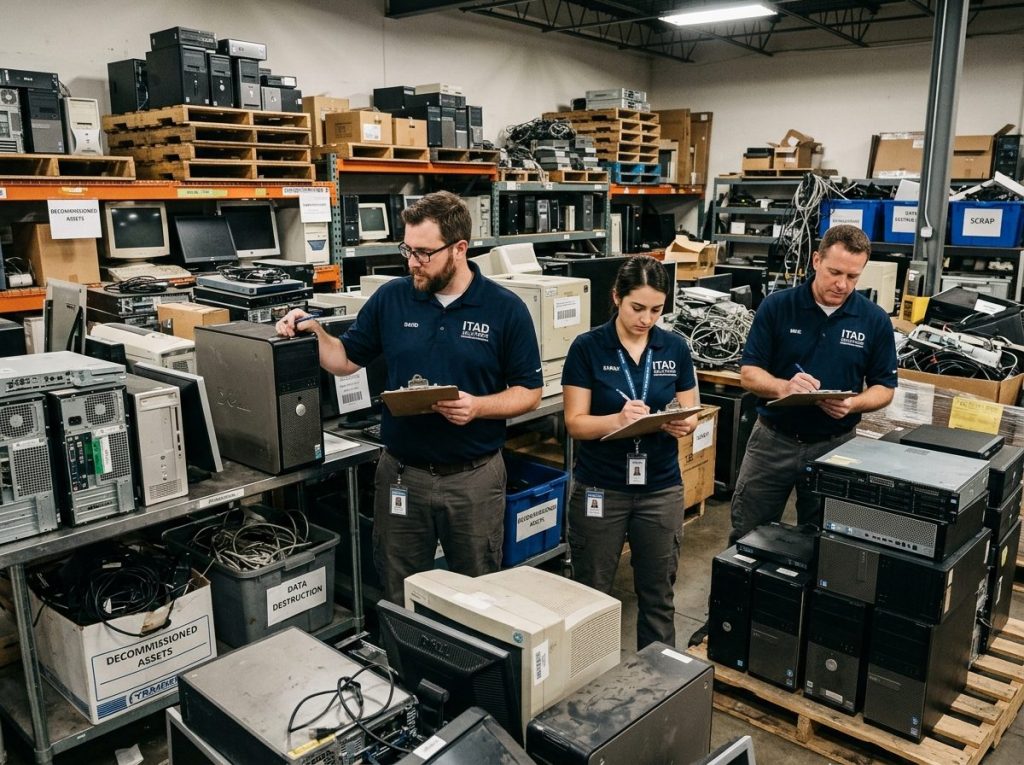
Your district just collected 3,000 Chromebooks at the end of the school year. The IT team deprovisioned them through the Google Admin console — removing user profiles, wiping enrolled accounts, and returning each device to its factory state. The devices are stacked on pallets in the warehouse, ready for your recycler.
From Google’s perspective, those Chromebooks are clean. From FERPA’s perspective, they are still loaded with recoverable student data. And the gap between those two realities is where your district’s compliance exposure lives.
What FERPA Requires for Device Disposal
The Family Educational Rights and Privacy Act (FERPA), codified at 34 CFR Part 99, mandates the protection of student education records maintained by educational agencies. The law’s scope is broader than many technology directors realize: “education records” encompasses any personally identifiable information (PII) maintained on district-managed devices, not just data stored in your Student Information System.
On a 1:1 Chromebook that a student has used for a school year, education records include cached login credentials, browsing histories tied to student accounts, assessment data from online testing platforms, behavioral records from classroom management software, documents and files synced to local storage, and in some cases, health information managed through district applications.
FERPA holds your district federally responsible for protecting this information until the device is “utterly destroyed” — meaning the data is rendered permanently irretrievable by any means. The U.S. Department of Education’s Privacy Technical Assistance Center (PTAC) has explicitly warned educational agencies that simple software wipes, file deletion, and factory resets are legally and technically insufficient for FERPA compliance.
This is not a suggestion or a best practice recommendation. It is the federal standard your district will be measured against if a complaint is filed, an audit is conducted, or a breach is reported.
Why Google Admin Deprovisioning Is Not Enough
The most common — and most dangerous — misconception in K-12 IT asset disposition (ITAD) is that deprovisioning a Chromebook through the Google Workspace for Education admin console constitutes compliant data destruction. Understanding why it doesn’t requires understanding how Chromebook storage works.
Modern Chromebooks use eMMC (embedded MultiMediaCard) flash storage — a type of solid-state memory soldered directly to the device’s motherboard. When you deprovision a device through Google Admin, the console removes the device from your management domain, clears user profiles and enrollment data, and triggers what amounts to a factory reset at the operating system level.
What Google Admin deprovisioning does not do is physically overwrite the underlying eMMC storage. The student data that was cached locally — browsing histories, assessment responses, login tokens, locally stored files — remains on the flash memory chips in unallocated storage space. The operating system can no longer see it, but forensic recovery tools can.
This is the same technical limitation that applies to factory resets on any solid-state storage device: the reset removes the software pointers to the data but does not overwrite the physical storage cells. For magnetic hard drives, overwrite-based sanitization tools can address this gap. For eMMC flash storage in Chromebooks, the architecture is more constrained — the storage is soldered to the board, there is no removable drive to process independently, and the device’s firmware may not support the manufacturer-specific secure erase commands that NIST 800-88 Rev. 2 requires for Purge-level sanitization of flash media.
The practical consequence for K-12 districts: for Chromebooks with eMMC storage, NIST 800-88 Destroy — physical shredding or disintegration of the device — is widely recognized as the only defensible standard for FERPA compliance. The device must be physically destroyed to guarantee that the student data on its eMMC chip is permanently unrecoverable.
Not sure where your district stands? Take the free ITAD Readiness Assessment →
The Regulatory Stakes
The consequences of a FERPA-related breach from improperly disposed devices are severe and multi-layered.
Federal funding risk. FERPA compliance is a condition of receiving federal education funding. While FERPA itself does not impose direct financial penalties, the Department of Education can withhold federal funds from districts found in violation — a consequence that dwarfs any ITAD-related cost.
State breach notification laws. Every state has breach notification requirements that apply to educational institutions. Laws like New York Education Law 2-d impose 30-day breach notification timelines with punitive consequences for non-compliance. When the breach originates from an improperly disposed student device, the notification obligation is triggered regardless of whether student data was actually accessed — the loss of control over the data is itself the reportable event.
Breach remediation costs. The average cost of data breach remediation in the education sector has reached $4.88 million per incident. For a school district operating on a constrained budget, this figure represents a crisis-level financial event — one that diverts resources from instruction, facilities, and student services.
Community trust. Parents entrust their children’s data to the district. A breach involving student records — particularly one caused by something as preventable as improper device disposal — erodes that trust in ways that are difficult to repair. The narrative that “the district gave away laptops with students’ personal information on them” is politically devastating regardless of the technical details.
ESSER Audit Implications
For districts that purchased Chromebook fleets using ESSER (Elementary and Secondary School Emergency Relief) funding, device disposition carries an additional compliance dimension. ESSER-funded devices are subject to federal asset tracking requirements, and districts must demonstrate compliant disposition of federally funded equipment to satisfy audit obligations.
The ESSER funding timeline creates specific pressure: districts were mandated to obligate final ARP funds by September 30, 2024, and to liquidate those funds by January 28, 2025. As federal audits of ESSER spending intensify, districts that cannot document the compliant disposition of federally funded devices — including serialized Certificates of Destruction — face audit findings that could require fund repayment.
If your district purchased devices with ESSER funds and those devices are now at or past their Auto Update Expiration (AUE) dates, you need a documented disposition process that satisfies both FERPA’s data destruction requirements and ESSER’s federal asset tracking requirements. A single Certificate of Destruction from a certified ITAD vendor can serve both purposes — but only if it’s serialized to the individual device level and cross-referenced to your district’s asset inventory.
Not sure where your district stands? Take the free ITAD Readiness Assessment →
Building a FERPA-Compliant Disposition Process
A defensible device disposal program for K-12 doesn’t require a massive budget or a dedicated compliance team. It requires a documented process with four components:
Inventory before you dispose. Every device scheduled for disposition must be inventoried by serial number and cross-referenced against your district’s asset management system. This step is particularly important for ESSER-funded devices, where the asset tracking must survive an audit. If your asset records are incomplete — and for many districts that deployed thousands of devices rapidly during the pandemic, they are — the disposition process is your opportunity to reconcile them.
Engage a certified vendor. Your ITAD vendor should hold R2v3 certification (responsible recycling and environmental compliance), NAID AAA certification (data destruction with unannounced audits), and ideally ISO 27001 (information security management). For K-12 Chromebook fleets specifically, confirm that the vendor’s destruction process addresses eMMC flash storage — not just removable hard drives. (For a detailed vendor evaluation framework, see: How to Choose an ITAD Vendor.)
Require serialized Certificates of Destruction. Each device must appear on the certificate by individual serial number, with the destruction method specified (physical shredding for eMMC-equipped Chromebooks), the date of destruction, and the vendor’s certification references. Batch-level receipts are not sufficient for FERPA or ESSER audit purposes. (For more on what makes a certificate defensible, see: What Is a Certificate of Destruction and Why It Matters.)
Use cooperative purchasing where available. Many ITAD vendors hold contracts with cooperative purchasing organizations that K-12 districts already use: E&I Cooperative Services, NASPO ValuePoint, BuyBoard (Texas), and state-level cooperatives. Procuring ITAD services through an existing cooperative agreement can significantly reduce procurement friction, bypass lengthy RFP cycles, and ensure pre-negotiated pricing.
Retain documentation for at least five years. FERPA requires retention of compliance records for the duration of the student’s enrollment plus five years after the last date of attendance. For device disposition, the safest approach is to retain Certificates of Destruction for at least seven years, aligning with the longest applicable retention requirement.
The Devices Beyond Chromebooks
While 1:1 Chromebook fleets dominate K-12 disposition volume, FERPA’s requirements apply to every device that maintained student education records:
iPads and student tablets retain higher remarketing value than Chromebooks, and Apple trade-in programs can offset disposition costs. But the same principle applies: factory resets on iPads do not guarantee data is unrecoverable from flash storage. Sanitization must meet NIST 800-88 Purge or Destroy standards.
Classroom desktops and computer lab workstations may contain locally cached student data from shared login sessions, assessment platforms, and educational software.
Campus security and surveillance systems are a heightened concern in K-12 environments because DVR/NVR systems contain video recordings of minors. Privacy considerations around video of children add a sensitivity dimension beyond standard data protection.
Interactive whiteboards and classroom displays contain embedded storage for saved presentations and may cache data from connected student devices. These are frequently overlooked in disposition planning.
Servers and network infrastructure contain Student Information System (SIS) backups, authentication directories, and network configurations. A server hosting your SIS backup contains the most complete and sensitive dataset in your district.
Not sure where your district stands? Take the free ITAD Readiness Assessment →
Where You Stand Matters
FERPA compliance for device disposal comes down to a single question: can your district prove, with serialized documentation, that every retired device containing student data was destroyed to a standard that renders that data permanently unrecoverable?
If your current process relies on Google Admin deprovisioning or factory resets as the final step before disposal, the answer is no — regardless of how thorough your cloud-side data management is. The data lives on the device’s physical storage, and it persists until that storage is physically destroyed.
The districts that navigate this well treat device disposition with the same compliance rigor they apply to student data privacy in active systems. They document every device, engage certified vendors, require serialized certificates, and retain the documentation to satisfy any audit that follows. The cost is modest relative to the fleet size. The cost of not doing it — measured in breach remediation, federal funding risk, and community trust — is not.
Ready to assess your district’s ITAD readiness? SureDispose’s free assessment evaluates your current practices across regulatory exposure, compliance gaps, data sanitization standards, vendor documentation, and chain of custody — and connects you with certified providers experienced in K-12 device disposition. Take the Assessment →
SureDispose is an independent advisory platform. We connect organizations with vetted ITAD service providers but do not perform disposition services directly. Providers compensate us for qualified introductions.