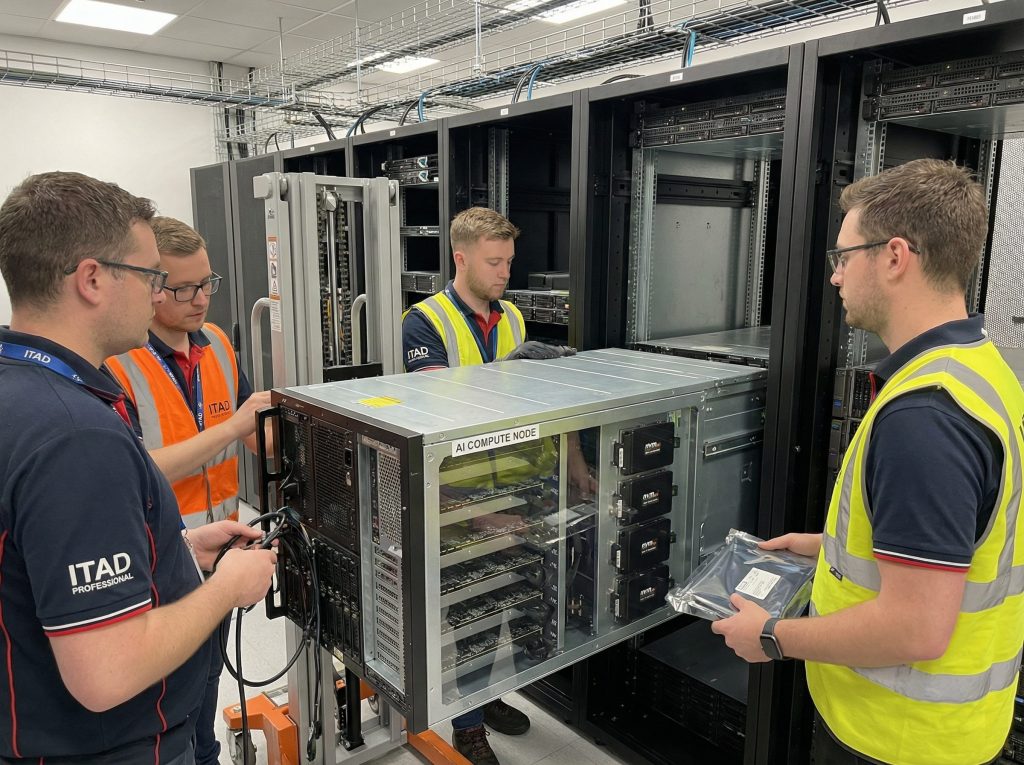
Decommissioning a data hall used to be a quarterly cleanup. Now it’s a compressed, multi-workstream program running against the arrival date of inbound GPU clusters that depreciate daily in storage. If the retirement event is mismanaged, the downstream damage is specific: a breach notification from a single unaccounted-for drive, a coolant spill that shuts down an adjacent hall, or a seven-figure value recovery miss because functional hardware got shredded in a panic. A working data center decommissioning checklist is the difference between a clean handoff and any of the above.
This guide walks through the five phases of a defensible decommissioning program: asset discovery, data sanitization at scale, physical extraction, environmental hazard management, and value recovery. Each phase has a failure mode that auditors, insurance carriers, and your CFO will eventually find. Working through them in sequence — before the first cable is pulled — is how mature operators avoid all of them.
What Does a Complete Data Center Decommissioning Checklist Actually Cover?
Treat decommissioning as a program, not an event. Five phases, sequenced, with clean handoff gates between each:
- Asset discovery and CMDB reconciliation — know what you have before anyone touches it
- Data sanitization at scale — render every drive unrecoverable, documented per serial number
- Physical extraction and logistics — de-rack, cable manage, remediate the space without disrupting adjacent operations
- Environmental hazard handling — batteries, coolants, and refrigerants routed through the correct regulatory paths
- Value recovery and intelligent triage — remarket, harvest, recycle, or destroy based on a deliberate disposition decision, not default behavior
Skip any one of these and the program stops being defensible. The sequence is load-bearing — you can’t sanitize what you haven’t discovered, and you can’t remarket what you’ve already shredded. For context on how IT asset disposition (ITAD) — the industry term for this entire lifecycle of retiring, sanitizing, and routing end-of-life hardware — fits into your broader infrastructure program, the discipline exists precisely because treating retirement as an afterthought is where organizations get burned.
Why Does Asset Discovery Fail Most Decommissioning Projects Before They Start?
Because the CMDB lies. Not deliberately — it drifts. Servers get moved without tickets, blades get swapped for RMAs without updates, and small-form-factor devices never make it into the inventory at all. By the time someone pulls a rack, the configuration management database and the physical reality have diverged enough to generate what auditors call ghost assets: equipment that appears on the books but isn’t in the cage, or equipment in the cage that isn’t on the books. Both are disqualifying.
The inventory accuracy benchmark worth knowing: elite ITAD programs maintain better than 99% asset reconciliation rates, while the historical industry average sits around 85%. That 14-point gap translates directly into missing drives, failed SOC 2 controls, and exposure under whatever regulatory regime applies to the data that used to live on the hardware.
Before extraction begins, the discovery phase needs to produce three artifacts:
- A verified rack-by-rack inventory with serial numbers cross-referenced against the CMDB or IT asset management (ITAM) system
- A reconciliation report identifying every discrepancy — ghost assets, rogue hardware, unlogged RMAs
- A signed-off manifest that will become the baseline for chain-of-custody tracking through sanitization and remarketing
Automated inventory reconciliation through optical character recognition (OCR) barcode scanning tied to a ServiceNow ITAM or comparable platform is table stakes at scale. Manual clipboards don’t work at 500 racks. They barely work at 50.
Not sure where your program stands on asset reconciliation maturity? Take the free ITAD Readiness Assessment →
What Does NIST 800-88 Rev 2 Require for Data Center Sanitization Today?
The short answer: a formal sanitization program, not just a sanitization procedure — and deference to IEEE 2883:2022 for the actual execution on modern media.
NIST SP 800-88 Revision 2 was finalized September 26, 2025, superseding Revision 1 which had governed media sanitization since 2014. If your internal policies still cite Rev 1, they’re stale. Rev 2 makes two consequential changes. First, it shifts focus from prescribing specific sanitization techniques to requiring an organization-wide media sanitization program aligned with broader frameworks like NIST SP 800-53 and ISO/IEC 27040. Second — and more operationally important — Rev 2 explicitly defers technology-specific execution to IEEE 2883:2022 for flash, NVMe, and other modern storage media.
IEEE 2883 matters at data center scale because the legacy multi-pass overwrite methods most ITAD vendors learned on (DoD 5220.22-M, the three-pass and seven-pass wipes) do not work reliably on modern NVMe SSDs. Flash media uses hidden overprovisioning sectors, wear-leveling algorithms, and zoned namespaces that sequential overwrites cannot address. Writing zeros across user-addressable blocks on a 30TB NVMe drive takes hours, wears down the NAND, and still leaves residual data in blocks the software can’t see.
IEEE 2883 defines three sanitization levels:
- Clear — logical overwrite of user-addressable data. Acceptable for internal reuse within the same security environment.
- Purge — cryptographic erase or firmware-level block erase commands. The gold standard for external remarketing. The drive’s own controller destroys the media encryption key, rendering the ciphertext mathematically unrecoverable in milliseconds.
- Destruct — physical destruction. Note that IEEE 2883 explicitly holds that standard shredding is insufficient for high-density flash because NAND chips can pass through conventional shredder grates intact. Pulverization, smelting, or incineration are required for true destruction of flash media.
For a hyperscale or enterprise data center decommissioning checklist, the practical implication is clear: your vendor’s sanitization workflow needs to execute IEEE 2883 Purge commands via automated erasure platforms like Blancco Drive Eraser, with a cryptographic Certificate of Erasure generated per serial number. The Iron Mountain engagement that retired 297 server racks and 122,000 data-bearing drives for a major hyperscale provider executed 100% sector-verified elimination on site in four days — that velocity is only possible with fleet-level automated erasure software, not manual wiping stations.
On-site sanitization is increasingly non-negotiable for data center workloads. The moment a data-bearing drive leaves the facility, chain of custody becomes a transit risk — and transit is where most disposition breaches happen. Mobile erasure arrays parked at the data center, with drives that fail the logical wipe routed immediately to an on-site industrial shredder before exiting the security perimeter, is the pattern that works at scale.
How Do You Handle Physical Extraction Without Disrupting Adjacent Operations?
The logistical part of a decommissioning program is where operational discipline gets tested. A standard enterprise migration of 50 to 100 racks typically requires 14 to 20 weeks of meticulous planning and execution. Hyperscale timelines are often brutally compressed below that because the floor space is spoken for by inbound AI infrastructure depreciating in a staging area.
Physical extraction has four workstreams running in parallel:
De-racking and labeling. Each asset gets tagged with a tamper-evident identifier at the moment it leaves the rack. This is the foundation of chain-of-custody documentation — the paper trail (now mostly digital) that proves exactly who had your equipment, when, and what happened to it at every step. Serial numbers alone aren’t enough; they’re prone to misrecording and manipulation. Tamper-evident tagging at the point of decommissioning creates a dual verification system that survives a contested audit.
Cable management. Modern AI workloads have driven the deployment of 400G and 800G fiber architectures with NVLink interconnects. Decommissioning these network topologies requires meticulous cable mapping — pulling cables blindly breaks adjacent production workloads. Document the topology before extraction begins.
Floor tile and space remediation. Under-floor work — power, cooling, cabling — needs to be coordinated with facilities. A cage that’s “vacant” but has active under-floor infrastructure from the prior tenant isn’t actually ready for reuse.
Operational isolation. Decommissioning work happens next to live production systems. The physical extraction plan needs airflow isolation, power cutover sequencing, and a clear boundary between the decommission zone and adjacent active racks. One powered cable pulled from the wrong patch panel takes down unrelated workloads.
The operational implication: the extraction phase is project management, not labor. Treat it that way or it runs over.
Which Environmental Hazards Do Data Centers Actually Trip On?
Four categories, each with its own regulatory pathway and its own failure mode.
Lithium-ion UPS batteries and battery-embedded equipment. Standard e-waste recyclers typically can’t handle large-format lithium batteries. These require specialized handling under state battery EPR laws and, increasingly, federal universal waste regulations (40 CFR Part 273). Improperly packaged lithium batteries are a genuine fire risk in transit — and a DOT violation.
Liquid cooling fluids. The power density jump from roughly 8 kW per rack in traditional enterprise deployments to 90 kW per rack in AI hyperscale environments has driven rapid adoption of direct-to-chip and full-tank immersion cooling. Those specialized coolants require controlled draining, containment, and disposal per environmental regulations. A coolant spill on a raised floor is a hazardous materials incident, full stop.
CRAC/CRAH refrigerants. Computer room air conditioning units contain refrigerants governed by Section 608 of the Clean Air Act. Recovery must be performed by an EPA Section 608-certified technician; improper venting carries federal penalties.
Heavy metals and legacy components. Older switchgear, PDU components, and legacy circuit boards can carry lead, mercury, or other RCRA-regulated substances requiring specialized abatement channels rather than standard e-waste streams.
The vendor handling your decommissioning needs to demonstrate current R2v3 or e-Stewards certification for downstream environmental compliance, plus documented EPA and DOT training for the hazmat categories specific to your facility. Ask for the downstream recycler list and the chain-of-custody documentation that extends past your vendor to every point of final disposition. “We recycle responsibly” without documentation is the phrase that shows up in FTC greenwashing actions.
Want to benchmark your vendor’s environmental and chain-of-custody posture? Take the free ITAD Readiness Assessment →
How Do You Triage Retired Assets for Maximum Value Recovery?
The default behavior — shredding everything — destroys value. A vendor shredding 100,000 high-capacity NVMe drives sacrifices millions in potential remarketing revenue and forecloses the environmental benefit of reuse. Intelligent triage routes every asset through a deliberate disposition decision rather than a blanket destruction policy.
Four disposition paths:
- Remarket — functional equipment that has been sanitized to Purge level gets recertified and sold into the secondary market. Server resale values have surged in the AI-constrained hardware environment; top-of-rack switches, high-speed optics, and recent-generation servers routinely return meaningful capital through remarketing channels, with some categories (memory modules, late-model NVMe) recovering a double-digit percentage of original cost.
- Harvest — components stripped from non-remarketable chassis (memory, CPUs, specific drive models) can be sold into the parts market at meaningful margin.
- Recycle — materials recovery through R2v3-certified downstream processors for units with no remarketing value but intact components.
- Destroy — failed media, data-bearing assets that failed logical sanitization, and classified-tier equipment. Required for some, but the default too often for the rest.
The financial models vary. The most common hyperscale arrangement is consignment revenue share — the ITAD vendor absorbs logistics, sanitization, and remarketing costs and splits gross proceeds with the client, typically 70-80% to the data center operator. At scale, that revenue meaningfully offsets CapEx on the inbound infrastructure that triggered the decommission in the first place.
The decision that drives recovery value is made during sanitization: Purge-level sanitization preserves the asset for remarketing; Destruct forecloses that option permanently. Routing every drive to a shredder because it’s operationally simpler is the single most common way data center programs leave seven figures on the table per engagement.
Where You Stand Matters
A decommissioning checklist is only as good as the handoffs between phases. Asset discovery that doesn’t reconcile cleanly to CMDB corrupts the sanitization manifest. Sanitization that doesn’t generate per-serial certificates fails the audit. Extraction that ignores environmental categories creates hazmat liability. Triage that defaults to destruction burns capital recovery.
The organizations that run defensible decommissioning programs treat it as exactly that — a program, with phase gates, documentation standards, and vendor accountability at every step. The ones that treat it as an event, a weekend project, or a line-item expense are the ones generating the breach notifications, the FTC actions, and the insurance claims that define the case studies.
If you’re evaluating where your program stands — discovery maturity, sanitization standards alignment, environmental compliance, value recovery sophistication — the assessment below benchmarks you against the practices that separate audit-clean operators from everyone else.
Ready to assess your organization’s ITAD readiness? SureDispose’s free assessment evaluates your decommissioning program across asset discovery, sanitization rigor, environmental compliance, and value recovery — then connects you with certified providers matched to your scale and requirements. Take the Assessment →
SureDispose is an independent advisory platform. We connect organizations with vetted ITAD service providers but do not perform disposition services directly. Providers compensate us for qualified introductions.