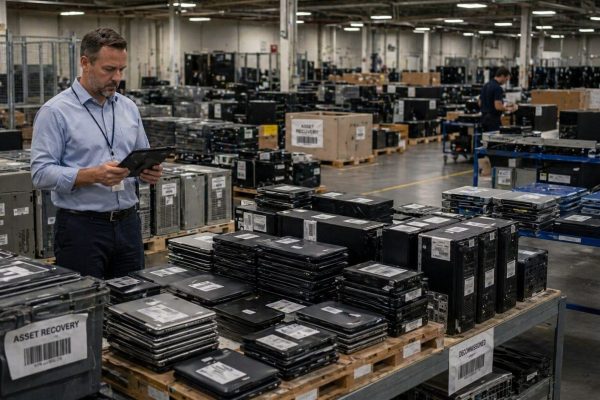
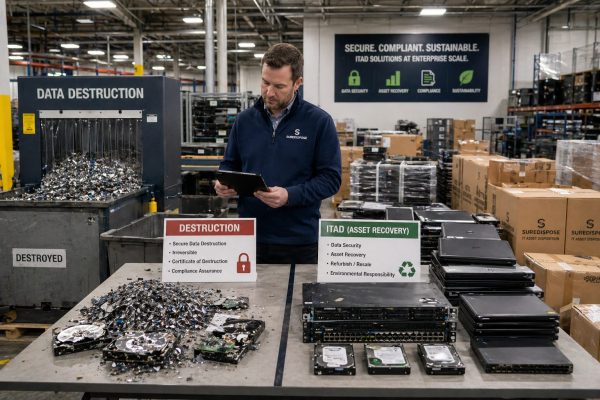
Every laptop, server, copier, and tablet your organization buys eventually has to leave. The question is how. The wrong answer is a unit pulled off a desk, a spreadsheet that doesn’t quite reconcile, and a year-end realization that nobody knows where any of it went. The right answer has a name: IT asset disposition, or ITAD. This guide explains what ITAD is, what happens during it, why it exists, and how you can tell whether your organization’s current approach is actually working.
What Does IT Asset Disposition (ITAD) Actually Mean?
IT asset disposition (ITAD) is the structured process of retiring end-of-life IT equipment in a way that protects the data on it, recovers any remaining value from it, and disposes of what’s left under the relevant environmental and regulatory rules. ITAD covers the full handoff: the moment a device is taken out of service, every step it goes through afterward, and the documentation that proves what happened.
A few distinctions are worth getting straight up front, because the words tend to be used interchangeably and they shouldn’t be.
ITAD is not the same as recycling. Recycling is what happens to the materials inside a device once they cannot be reused. It’s one possible outcome of an ITAD process, not a synonym for it.
ITAD is not the same as destruction. Destruction (shredding, crushing, degaussing) is one of three sanitization paths under the federal standard. It is sometimes the right answer; it is rarely the only answer.
ITAD is not the same as “getting rid of old equipment.” The phrase implies offloading. ITAD implies a chain: who had it, what was done to it, what state it left in, and where it ended up. The chain is the product.
A useful working definition: ITAD is the discipline of getting end-of-life IT equipment from your environment to its final, defensible resting place, with the data gone, the value extracted, the regulations satisfied, and the paper trail intact.
What Happens to Your Equipment Across the ITAD Lifecycle?
A mature ITAD program runs through four operational stages. They happen in sequence, but they aren’t independent; weakness in any one of them undermines the others.
1. Secure Logistics and Chain of Custody
The single most vulnerable window in the entire lifecycle is the moment a device leaves your active network. The firewalls, intrusion detection, and endpoint monitoring that protected it while it was in use stop applying the second it’s powered down and rolled out the door. From that point until sanitization is complete, physical control is the only protection.
Secure logistics covers how devices are collected from your sites, how they’re tracked unit by unit (typically by serial number), how they’re transported, and how that transport is documented at every handoff. Chain of custody is the running record of who had which device, when, and what they did with it. Both are auditable; neither is optional.
2. Data Sanitization
Sanitization is the irreversible removal of data from storage media so that no residual data can be recovered, even by a forensic specialist. The federal standard is NIST Special Publication 800-88. As of October 2025, NIST SP 800-88 Revision 2 (September 2025) supersedes the long-standing Revision 1 from 2014 and is the version organizations should now reference.
NIST 800-88 defines three sanitization methods at increasing levels of assurance:
- Clear uses standard read/write commands to overwrite user-addressable storage. Suitable for low-sensitivity media that will stay in your environment.
- Purge uses logical or physical techniques (cryptographic erase, block erase, degaussing) to render data recovery infeasible even with laboratory tools. Suitable for media leaving your control.
- Destroy physically destroys the media (shredding, pulverization, incineration). The final option when the media cannot be reliably purged or when policy requires it.
Rev. 2 also formally aligns with IEEE 2883:2022, which specifies the device-level commands modern flash storage and SSDs need to actually achieve those outcomes. NIST 800-88 establishes the policy: what to sanitize and to what level. IEEE 2883 specifies how the device itself implements it.
Done correctly, every sanitized device leaves with a Certificate of Destruction (or Certificate of Sanitization) tied to its serial number. Done incorrectly, you have a “wipe” with no proof and no defensible record.
3. Remarketing and Value Recovery
A surprising portion of retired IT equipment still has resale value. Three-year-old laptops, recent-generation servers, and well-maintained networking gear can often be refurbished and resold into secondary markets, returning meaningful revenue back to the organization that owned them. Remarketing is the part of the ITAD program that captures that value: testing, refurbishing, grading, listing, and selling assets that are still serviceable.
Remarketing only works after sanitization is complete and certified. Selling a device that hasn’t been verifiably wiped is how data ends up on auction sites; an outcome we’ll come back to in the next section.
4. Responsible Recycling
Whatever cannot be reused gets recycled. Responsible recycling means the materials are processed under environmental standards (R2v3, e-Stewards) that prevent toxic components from being landfilled domestically or shipped offshore to informal processors. This is both an ethical and a regulatory matter; e-waste laws at the state level and the Basel Convention at the international level both impose real obligations on the generator of the waste, not just the recycler.
Not sure where your organization stands across these four stages? Take the free ITAD Readiness Assessment →
Why Does ITAD Matter? The Two Risks Every Program Has to Manage
Two risks, fundamentally. Everything else is downstream of these.
Risk 1: Data Exposure
A retired device is not an empty device. Drives that look erased typically aren’t. Factory resets, in particular, leave underlying data recoverable; the U.S. Department of Education’s Privacy Technical Assistance Center has been explicit on this point in its FERPA guidance for school districts, and NIST has been similarly clear in 800-88’s framing for federal systems. The data is still there until it has been sanitized to a defensible standard.
When that doesn’t happen, the consequences scale fast. The most heavily cited case in the industry is Morgan Stanley’s data center decommissioning matter. Beginning in 2016, the bank engaged a moving and storage company without data destruction expertise to handle the decommissioning of two wealth management data centers; thousands of devices containing unencrypted customer data subsequently surfaced for sale on the public secondary market. A separate 2019 hardware refresh resulted in 42 servers that could not be located. The bank’s cumulative regulatory and civil exposure ultimately reached approximately $161.5 million, broken out as follows:
- The Office of the Comptroller of the Currency assessed a $60 million civil money penalty in 2020, citing what it described as unsafe or unsound practices in subcontractor oversight and customer data inventory.
- The Securities and Exchange Commission imposed a $35 million settlement in 2022 related to the disposal failures.
- The New York State Attorney General reached a $6.5 million settlement.
- A related class action settlement and remediation costs accounted for the remainder.
The number that gets quoted is the headline. The lesson underneath it is the part worth remembering: the bank’s regulatory exposure didn’t transfer to the disposal vendor. It stayed where it started.
That principle generalizes. Across enforcement records under HIPAA, GLBA, FERPA, and state data privacy laws, regulators have consistently treated the original data custodian, not the disposition vendor, as the responsible party. Vendors get sued contractually. Custodians get fined regulatorily. The two are not interchangeable.
Risk 2: Compliance Failure
ITAD intersects with a thicket of regulations that vary by sector and state. A short, illustrative list:
- HIPAA (45 CFR §164.310(d)(2)(i)) requires covered entities and business associates to address final disposition of electronic protected health information. HHS OCR’s 2024 Annual Civil Money Penalty schedule caps Tier 4 violations at roughly $2.07 million per identical violation per calendar year.
- FERPA (34 CFR Part 99) requires school districts to protect personally identifiable student information through the device’s final destruction. The Department of Education’s published guidance is that simple software wipes and factory resets are not sufficient.
- GLBA Safeguards Rule requires financial institutions to implement disposal procedures for customer information; SOX §404 requires public companies to maintain documented internal controls over data including at end-of-hardware-life.
- State e-waste laws (California’s SB 20, Illinois’ CERA, and others) prohibit electronics in municipal solid waste and impose generator liability on the organization that originated the device.
- Basel Convention amendments effective January 1, 2025 regulate the transboundary movement of all electrical and electronic waste, regardless of hazard classification, expanding documentation requirements for any cross-border ITAD activity.
None of these regulations get satisfied by a well-intentioned spreadsheet. They get satisfied by documented procedures, certified sanitization, and an auditable chain of custody. Which is what ITAD, done properly, produces.
What Standards and Certifications Tell You a Vendor Is Real?
The ITAD market is large and growing fast (estimates put it at roughly $17.5 billion globally in 2025, projected to more than double by 2035), and the population of vendors ranges from highly mature operators to single-truck operations whose differentiation is price. Certifications are the shorthand the industry uses to separate them. Four matter most:
- NIST SP 800-88 Revision 2 (September 2025). Not a vendor certification, but the federal media sanitization standard a credible vendor’s process should map to. Ask which methods (Clear, Purge, Destroy) the vendor uses for which media types and how the choice is documented per device.
- IEEE 2883:2022. The device-level standard that operationalizes 800-88 for modern storage media (NVMe SSDs, eMMC, UFS). NIST 800-88 Rev. 2 explicitly defers low-level execution mechanics to it.
- NAID AAA Certification. Administered by i-SIGMA, NAID AAA is a data-destruction-specific standard with rigorous physical security, employee screening, and unannounced audit requirements. It is the closest thing the industry has to a security baseline for the destruction operation itself.
- R2v3 and e-Stewards. Environmental standards governing how the recycling side of the lifecycle is handled, including downstream material tracking and the prohibition on offshoring untested waste.
A vendor who cannot describe how their process maps to NIST 800-88 Rev. 2, cannot produce serial-level certificates of destruction, or does not hold current R2v3 or NAID AAA certification is signaling a documentation gap that will surface in your next audit.
Comparing vendor proposals? The free ITAD Readiness Assessment → generates a vendor-readiness scorecard you can use to evaluate offers against your organization’s specific compliance profile.
How Do You Know If Your Organization Needs ITAD Support?
Most organizations underestimate how much exposure their current approach carries; partly because the failure modes are quiet ones. Equipment piles up in a closet, gets handed to a “guy who comes by every quarter,” or goes home with departing employees. None of those events generate an audit ticket on the day they happen. The audit ticket comes later.
A short list of signals that your current ITAD approach is undersized for the risk:
- You can’t produce serial-level certificates of destruction for the equipment you retired in the last 12 months.
- Your last hardware refresh ended with a pallet of devices in storage that nobody has revisited.
- Industry research has put the average time organizations store decommissioned equipment before disposal at roughly 2.7 years; if your number is anywhere close to that, the storage is the risk.
- Your current vendor cannot tell you which of your serial numbers were physically destroyed versus logically wiped versus remarketed.
- You operate under HIPAA, GLBA, FERPA, SOX, PCI-DSS, or any state data privacy law (CCPA, NYDFS, MA 201 CMR 17, others) and your disposal procedures are not documented to the level your other security controls are.
- You are about to undergo a regulatory examination, an acquisition, or a multi-site consolidation, and ITAD is not in the readiness checklist.
If any of those describe your environment, the gap is not knowledge; the gap is a documented program. ITAD is the program.
Where You Stand Matters
The two questions worth answering are knowable ones: what’s your current level of ITAD risk, and what kind of provider would actually fit your organization’s compliance profile, asset volumes, and operational footprint? Neither requires a long engagement to answer. Both require a structured look at where you are now, which is what the assessment is for.
ITAD isn’t complicated once you know what you’re looking at. The four stages (logistics, sanitization, remarketing, recycling), the two risks (data exposure, compliance failure), and the certifications that separate real vendors from price-driven operators are the entire shape of the field. What’s hard is doing the structured walkthrough of your own environment to figure out where you stand against each of them. That’s the part SureDispose is built for.
Resources
- NIST SP 800-88 Revision 2 (September 2025): the current federal media sanitization standard.
- IEEE 2883-2022: device-level sanitization specifications referenced by NIST 800-88 Rev. 2.
- i-SIGMA / NAID AAA Certified Member Directory: verify a vendor’s NAID AAA certification status.
- SERI / R2v3 Certified Recycler Directory: verify a vendor’s R2v3 certification status.
Ready to assess your organization’s ITAD readiness? SureDispose’s free assessment evaluates your current practices across data sanitization, chain of custody, vendor controls, and compliance documentation, then connects you with certified providers matched to your industry and asset profile. Take the Assessment →
SureDispose is an independent advisory platform. We connect organizations with vetted ITAD service providers but do not perform disposition services directly. Providers compensate us for qualified introductions.
This article is educational. It summarizes publicly available regulations, enforcement records, and industry standards as of April 2026 and does not constitute legal advice. Regulatory applicability to your organization depends on facts SureDispose cannot evaluate from outside your environment; compliance determinations should be made in consultation with qualified counsel. References to specific enforcement actions reflect the published findings of the regulator identified and are not independent characterizations by SureDispose.