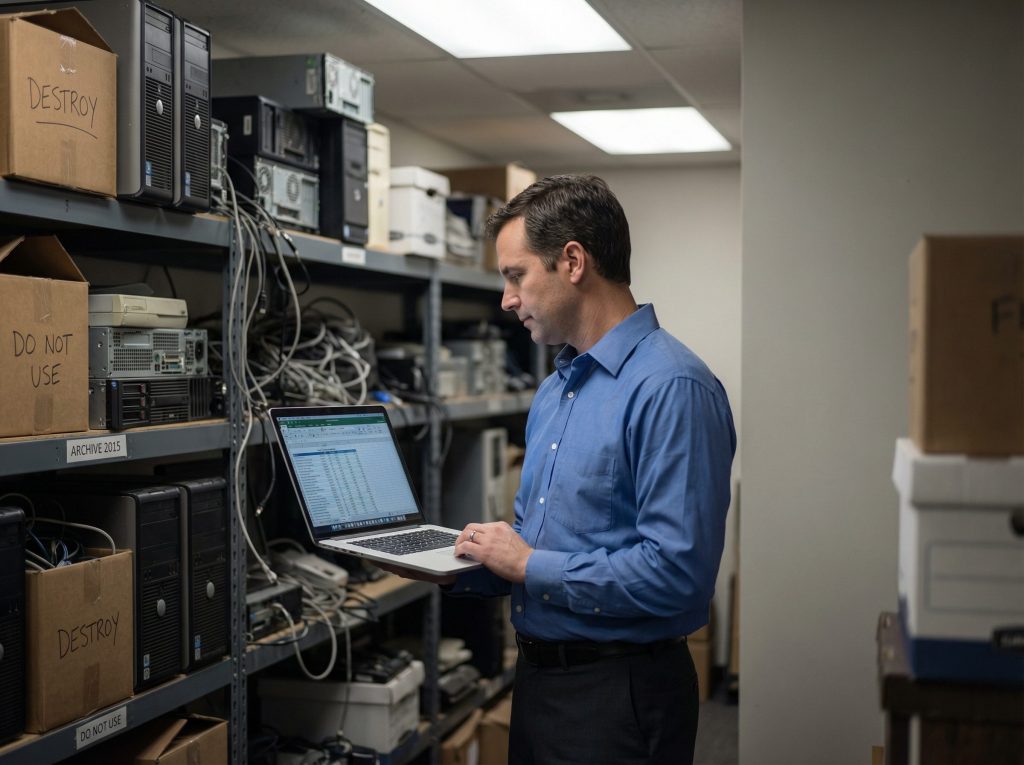
Your data center team just got the memo. The racks of GPU servers you stood up eighteen months ago are already on the refresh list, and the ones coming in behind them are denser, hotter, and worth more per rack than anything your ITAD vendor has ever touched. This is not a drill. The first real wave of AI server decommissioning is hitting right now, and most ITAD programs were built for a world that no longer exists.
Here is the thing. According to Li Tong Group, the first real wave of GPU dense AI servers is entering decommissioning cycles between 2026 and 2029, driven by the massive GPU buildouts that happened between 2022 and 2024. At the same time, NIST published SP 800 88 Revision 2 on September 26, 2025, which quietly rewrote the playbook for how you are expected to sanitize the SSDs and NVMe drives sitting inside those retired servers. If your internal policy still says “wipe drives” and points to the 2014 version of the standard, you are already behind.
Let me break down what is actually changing and what you need to do about it.
What Makes AI Server Decommissioning Different From Regular ITAD?
A single AI server can hold eight or more high value GPUs, terabytes of high bandwidth memory, and multiple data bearing NVMe drives that may contain proprietary model weights, training datasets, or customer data used for fine tuning. That is not a retired office laptop. That is a concentration of asset value and data risk in one chassis, often weighing over 1,100 kilograms per rack in the case of systems like the NVIDIA DGX SuperPOD.
Treating AI server decommissioning like standard server disposal creates gaps on three fronts at once: data security, value recovery, and physical handling. Most legacy ITAD workflows were built around x86 servers with SATA drives and predictable form factors. AI infrastructure breaks all of those assumptions. The drives are faster and harder to sanitize correctly, the components are worth five to ten times more on the secondary market, and the racks themselves often require mechanical lifts and liquid cooling fluid handling just to get them out of the building safely.
What Does NIST 800 88 Rev. 2 Actually Require Now?
The short version: NIST 800 88 Rev. 2 pushed organizations to stop treating sanitization as a single procedure and start treating it as a decision tree based on media type. For modern SSDs and NVMe drives, that typically means cryptographic erasure followed by a verified purge, with a documented certificate tied to the serial number of every data bearing device.
The older Rev. 1 guidance, published back in 2014, did not fully account for how SSDs actually store and retain data across wear leveling and over provisioned cells. Rev. 2 closed that gap. Practically, this means your sanitization policy needs to specify different controls for HDD, SSD, NVMe, removable media, and tape, and your vendor scorecards need to require verification artifacts for each one.
Tools like Blancco Drive Eraser produce tamper evident certificates of erasure that map directly to these requirements, which is what an auditor will ask for first. If your vendor cannot produce a certificate tied to a specific serial number in under ten minutes, your process is vulnerable.
How Much Value Is Actually Sitting in Those Retired AI Servers?
More than you think. A used enterprise GPU can still command thousands of dollars on the secondary market, and a full AI server chassis can represent a significant recovery opportunity if it moves through a qualified remarketing channel instead of straight to shred.
Microsoft reported a 90.9% reuse and recycling rate for servers and components in 2024 through its circularity program, with more than 3.2 million components reused. That is the benchmark. Most organizations are nowhere close, and every GPU that goes to shred when it could have been remarketed is cash walking out the door. The catch is that you only capture that value if your chain of custody holds up and your data sanitization is defensible. No buyer wants a GPU with questions attached to it.
What Should You Actually Do Before the Next AI Refresh?
Start with four things.
- Pre book decommissioning windows with a certified ITAD partner before the refresh schedule lands on your desk. Capacity for AI hardware processing is tight, and the vendors who can handle GPU dense servers at scale are already booking out.
- Update your sanitization policy language to align with NIST 800 88 Rev. 2 and require device specific controls for SSD and NVMe media.
- Tighten your chain of custody so you can trace any serial number from the rack to final disposition in minutes, not days.
- Verify your vendor is actually R2v3 certified through the Sustainable Electronics Recycling International directory, not just claiming it on a website.
Auditors look for R2v3 first, and it has become a common procurement requirement for any organization with defensible downstream expectations.
So Where Does This Leave Your ITAD Program Heading Into the Rest of 2026?
The honest answer is that AI server decommissioning has turned ITAD from a back office cleanup task into a strategic function that protects your data, captures real financial value, and keeps you defensible in front of regulators and auditors. The organizations that win over the next three years will be the ones that updated their policies to NIST Rev. 2, locked in capacity with vendors who can actually process GPU dense hardware, and built chain of custody tight enough to produce an answer on any serial number inside ten minutes. Start with your sanitization policy this week, pre book your next decommissioning window, and make sure the vendor on the other end of it has the certifications and the power capacity to handle what you are about to send them. That is the foundation. Everything else builds from there.