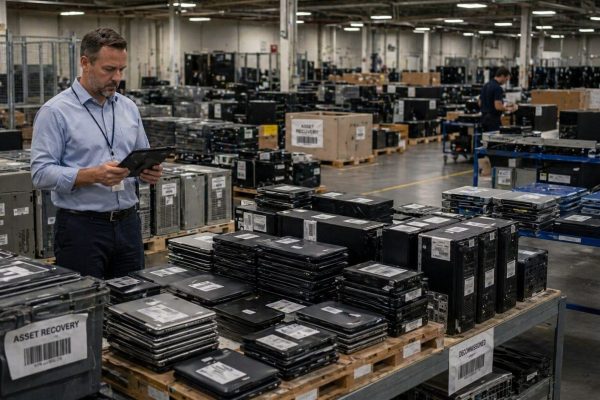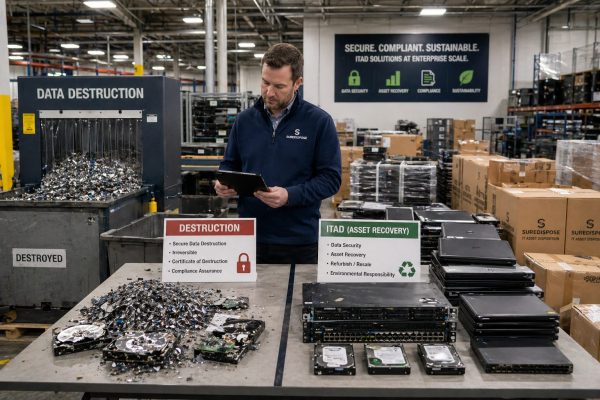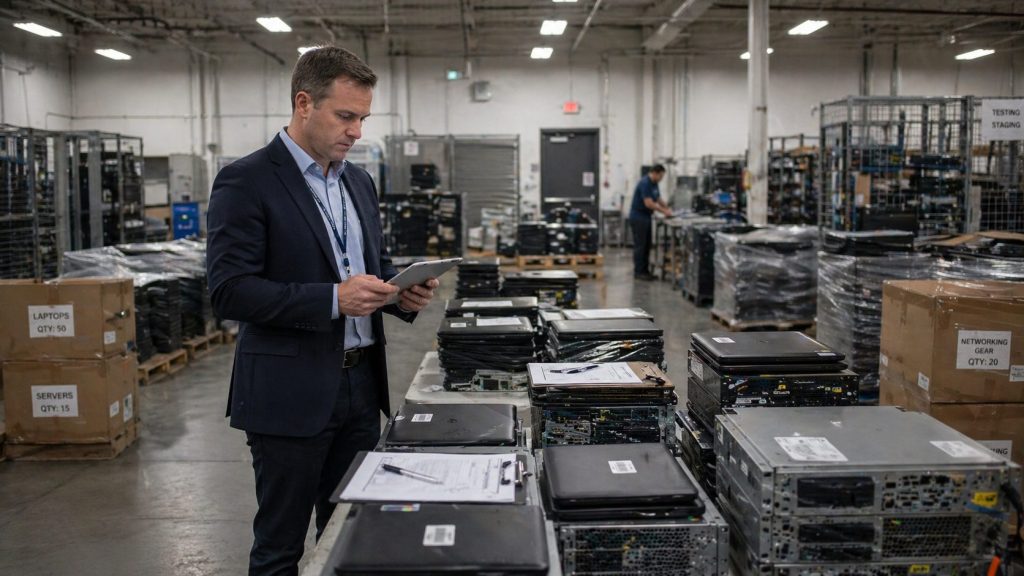
The IT asset disposition (ITAD) market is large, fast-growing, and uneven. Industry estimates put it at roughly $17.5 billion globally in 2025, projected to more than double by 2035. Inside that market, vendors range from highly mature operators with global processing footprints down to single-truck operations whose differentiation is price. Telling them apart from the outside is harder than it should be, because everybody’s website has the same words on it. This guide gives you a framework for cutting through that: what to require, what to verify, what to negotiate, and what to walk away from.
The reader this is written for is the person actually buying: an IT director, security or compliance lead, procurement officer, or office manager comparing two or three proposals and trying to figure out which one is real.
Why Is Choosing an ITAD Vendor So Hard?
Two things make this category harder to evaluate than most.
First, the failure modes are quiet. A bad vendor doesn’t fail the way a bad payroll system fails. The data shows up on a secondary market two years later. The chain of custody falls apart in an audit you didn’t know was coming. The recycler you trusted gets named in a state environmental enforcement action and so do you, as the generator. Standard procurement comparison points (price, timeline, account manager experience) don’t surface any of this.
Second, the market uses certifications as binary qualification gates rather than as competitive differentiators. Enterprise procurement teams treat the absence of R2v3, NAID AAA, and ISO 27001 as automatic disqualification before they evaluate a vendor’s commercial terms. That posture is worth borrowing whether or not you’re a Global 2000 buyer; the certification stack is what separates vendors whose process is contractually audited from vendors whose process is whatever they tell you it is.
A useful working stance: certifications are the floor, not the ceiling. Once a vendor clears that floor, the questions worth asking are about how they execute, what they document, and what their commercial terms actually mean. The next four sections walk through each of those.
Which Certifications Should Be Non-Negotiable for ITAD Vendors?
Three certification stacks separate vendors with audited operations from vendors who self-attest. A serious ITAD provider holds at least one item from each row.
Environmental and recycling: R2v3 or e-Stewards. Both are independent, recurring-audit certifications that govern how electronics are recycled at end of life, how downstream vendors are tracked, and what gets prohibited (such as offshoring untested e-waste to developing countries). R2v3 is the current major revision of the R2 standard, administered by SERI; e-Stewards is administered by the Basel Action Network. Most U.S. ITAD operators carry one or the other; some carry both. A vendor without either is not contractually bound to the audit standards those certifications enforce.
Secure data destruction: NAID AAA. Administered by i-SIGMA, NAID AAA is specific to the destruction operation itself: physical security of the facility (badged access, 24-hour CCTV with at least 90 days of retention, locked processing areas), employee screening (background checks, drug screening, I-9 verification), and unannounced audits. It is the closest thing the industry has to a security baseline for the people and the building, not just the process. NAID AAA covers both physical destruction and logical sanitization paths.
Information security management: ISO 27001. A general-purpose information security standard certifying that the vendor operates a documented Information Security Management System with risk assessments, access controls, incident response, and ongoing review. Less ITAD-specific than NAID AAA, but it tells you the vendor has institutional security discipline beyond the shredder room.
There are useful supplementary certifications (ISO 14001 for environmental management, ISO 45001 for occupational health and safety, SOC 2 Type II for service organization controls) that come up in larger procurements. They’re worth seeing on the shelf but they don’t substitute for the three above.
A practical evaluation move: ask each shortlisted vendor to provide their current certification numbers and the directories where you can verify them (the i-SIGMA NAID member directory, the SERI R2 directory, the certification body issuing the ISO certificate). A vendor who can’t produce verification on a phone call is signaling something.
Comparing certifications across multiple vendor proposals? Take the free ITAD Readiness Assessment → and we’ll generate a vendor-readiness scorecard calibrated to your industry’s specific compliance profile.
What Sanitization Standards Should the Vendor’s Process Map To?
Certifications tell you a vendor is audited. Sanitization standards tell you what they actually do to your data. Two reference standards matter:
NIST Special Publication 800-88 Revision 2 (September 2025). The federal media sanitization standard, finalized September 26, 2025, superseding the long-standing Revision 1 from 2014. Rev. 2 is a meaningful shift; it moves the focus from prescribing specific wipe methods to requiring that organizations operate a documented media sanitization program with vendor trust, validation, and evidence the auditor can defend. Cascade Asset Management’s 2025 benchmarking research has reported that roughly half of enterprise buyers now mandate strict NIST 800-88 compliance from their ITAD vendors.
IEEE 2883:2022. The device-level standard that NIST 800-88 Rev. 2 explicitly defers to for the actual technical execution. IEEE 2883 specifies the firmware-level commands modern flash storage (NVMe SSDs, eMMC, UFS) must support to reliably achieve the Clear, Purge, or Destroy outcomes that NIST 800-88 defines.
NIST 800-88 defines three sanitization methods in increasing strength:
- Clear uses standard read/write commands. Suitable for low-sensitivity media that will stay in your environment.
- Purge uses logical or physical techniques (cryptographic erase, block erase, degaussing) to render data recovery infeasible even with laboratory tools. Suitable for media leaving your control.
- Destroy physically destroys the media. The final option when media cannot be reliably purged or when policy requires it.
The questions to put to a vendor:
- What method (Clear, Purge, or Destroy) do you apply to which media types, and how is that decision documented per device?
- How do you validate sanitization? Is the validation independent from the tool that performed the sanitization?
- For self-encrypting drives or encrypted storage, how do you handle cryptographic erase, and what is your key management practice?
- What does the Certificate of Sanitization or Certificate of Destruction look like, and is it tied to a specific serial number?
- How does your tooling get updated when standards change (e.g., the move from Rev. 1 to Rev. 2)?
A vendor who cannot answer those without escalating to a sales engineer has a documentation gap. A vendor who answers them by handing you their published SOP has done this before.
How Should Chain of Custody and Documentation Work?
Chain of custody is the running record of who had which device, when, and what they did with it. It starts at your loading dock and ends at the device’s final, defensible resting place. Every handoff in between gets documented or the chain breaks.
A serious ITAD vendor’s chain-of-custody process includes:
- Serial-level inventory at pickup. Every device is logged by serial number on-site before it leaves your facility. Bulk weight manifests are not chain of custody.
- Tamper-evident transport. Numbered tamper-evident seals on transport containers, with seal numbers recorded on both the pickup manifest and the receiving manifest at the processing facility.
- Tracked logistics. GPS-tracked vehicles, ideally TAPA-certified for higher-sensitivity loads. Document the carrier; document the route restrictions if any apply.
- Two-person verification on receipt. When the load arrives at the processing facility, two people independently verify the seal numbers, the device count, and the serial inventory.
- Serial-level certificates. A Certificate of Destruction or Certificate of Sanitization issued per serial number, mapping the unit to its sanitization method, date, operator, and outcome. Certificates that are batch-level rather than serial-level have limited audit value.
- Cross-referenced asset reconciliation. Your final delivered report should reconcile against the inventory you provided at pickup. If you handed over 500 units, the report should account for 500 units; what was sanitized and remarketed, what was sanitized and recycled, what was destroyed, and any exceptions.
For higher-sensitivity programs (financial services, healthcare, government, classified data), expect to add: client-witnessed destruction (in person or via vendor-recorded video retained for the bank or agency’s audit period), on-site sanitization options (mobile shredding or on-site purge before any device leaves the building), and pre-procurement on-site audits where your security team physically inspects the vendor’s processing facility, observes the operations, and reviews the SOPs before signing.
A vendor who pushes back on serial-level certificates, on-site audits, or cross-referenced reconciliation may be cost-effective. They are also the vendor whose paperwork doesn’t survive an OCR audit, an FFIEC examination, or a state attorney general subpoena.
Not sure what level of chain-of-custody documentation your industry requires? Take the free ITAD Readiness Assessment → for a calibrated readiness scorecard.
What Commercial Terms and Red Flags Should You Watch For When Evaluating ITAD Vendors?
Most of the discussion above is about what the vendor does. This section is about what the contract says they’re on the hook for, and what their commercial structure tells you about how they make money.
Settlement model and revenue share. Many ITAD vendors operate on a hybrid model: the buyer pays for sanitization, logistics, and disposal services; the vendor returns a percentage of the resale value when retired equipment can be remarketed. The percentage matters; how it’s calculated matters more. Ask: how is secondary-market value determined? Is it auction-driven, fixed-pricing, or dealer-quoted? How is the revenue share audited? “Pricing creep” (where unexpected logistical fees, downstream audit charges, or opaque settlement adjustments erode the contract value over time) is the most commonly cited procurement frustration in ITAD. The defense is settlement transparency in writing, with audit rights.
Insurance and indemnification. A real ITAD provider carries professional liability and cyber liability insurance with limits sized to the data they handle. The contract should include indemnification language that covers data breach scenarios resulting from the vendor’s failure to sanitize, and it should not cap that liability at the contract value (a $50,000 services contract paired with a $50,000 liability cap is meaningless against a multi-million-dollar breach). Ask for the certificate of insurance (COI) and read the cyber liability section before signing.
Business Associate Agreement (BAA) or data processing agreement. Required if you’re a HIPAA covered entity or business associate (45 CFR §164.308(b)) and standard practice if you’re handling personal data under state privacy laws or GDPR. A vendor who balks at signing a BAA is signaling that they don’t routinely handle PHI, which is a fact about their operation, not a negotiation position.
Downstream visibility. Where do materials go after they leave the vendor’s facility? A serious vendor can name their downstream partners and produce certifications for each. R2v3 and e-Stewards both require this kind of downstream tracking; a vendor who cites those certifications but cannot name their downstream partners is selectively reading their own audit.
Red flags worth taking seriously:
- The vendor cannot describe how their sanitization process maps to NIST SP 800-88 Rev. 2.
- The vendor offers only batch-level certificates, not serial-level.
- The vendor cannot or will not allow an on-site audit before contract signing.
- The vendor’s pricing is meaningfully below the market and the explanation is “we’re more efficient.” (The explanation is more often “we don’t carry the certifications.”)
- The vendor cannot explain who their downstream partners are or where materials end up.
- The vendor’s contract caps total liability at the contract value or a small multiple of it.
- The vendor cannot produce a current COI for cyber liability insurance.
None of these are individually disqualifying in every context. Two or more of them in the same proposal is a pattern.
Where You Stand Matters
The vendor evaluation question and the readiness question are the same question, posed from two angles. “Which vendor should I choose” depends on what compliance profile your organization actually has, what asset volumes you actually move, what your industry’s documentation standard actually is, and what the cost of a chain-of-custody gap actually looks like for you specifically. None of those are knowable from a vendor’s proposal; they’re knowable from a structured look at your own environment.
That structured look is what the assessment is built to do. It produces a readiness profile (where you stand against the standards your industry’s regulators apply), a vendor-readiness scorecard (what to require in an RFP given your specific compliance picture), and a shortlist of providers whose certification stack and operational footprint match your actual requirements. The work the assessment does in five minutes is the work most organizations don’t do at all, which is why most vendor selections come down to price.
Choosing an ITAD vendor is not complicated once you know what you’re looking at. Certifications as the floor. Sanitization standards as the technical spine. Chain of custody as the operational discipline. Commercial terms as the legal backstop. A vendor that’s serious meets all four; a vendor that’s cheap usually meets none of them, and the cost of finding out shows up later, in a place you don’t want it to.
Resources
- NIST SP 800-88 Revision 2 (September 2025): the current federal media sanitization standard.
- IEEE 2883-2022: device-level sanitization specifications referenced by NIST 800-88 Rev. 2.
- i-SIGMA NAID AAA Certified Member Directory: verify NAID AAA certification status.
- SERI / R2v3 Certified Recycler Directory: verify R2v3 certification status.
- Basel Action Network e-Stewards Certified Recycler Map: verify e-Stewards certification status.
Ready to assess your organization’s ITAD readiness? SureDispose’s free assessment evaluates your current practices across data sanitization, chain of custody, vendor controls, and compliance documentation, then connects you with certified providers whose certification stack and operational footprint match your industry and asset profile. Take the Assessment →
SureDispose is an independent advisory platform. We connect organizations with vetted ITAD service providers but do not perform disposition services directly. Providers compensate us for qualified introductions.
This article is educational. It summarizes publicly available regulations, industry standards, and procurement practices as of April 2026 and does not constitute legal advice. Regulatory applicability to your organization depends on facts SureDispose cannot evaluate from outside your environment; compliance determinations and contract terms should be reviewed by qualified counsel. References to specific certifications, standards, and procurement frameworks reflect publicly available documentation from the issuing body identified.