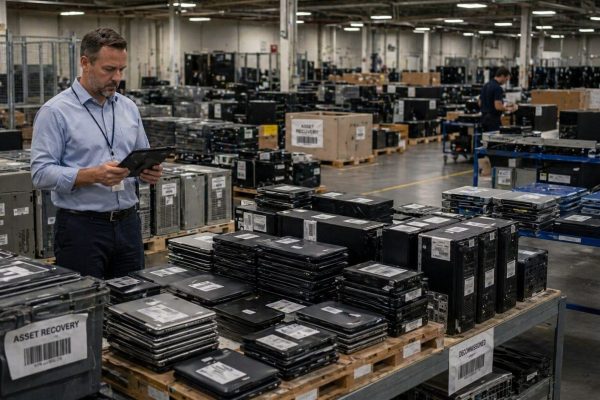
If your search started with “IT asset destruction,” your situation probably has urgency attached to it. A breach response, a classified-data engagement, a litigation hold, an equipment refresh where the security team wants drives shredded before anything else happens. The natural instinct is to call a destruction vendor and have them shred everything. Sometimes that’s exactly right. Often it’s an expensive way to throw away equipment that should have gone through a different process.
This guide explains what IT asset destruction actually is as a service category, when it’s the correct standalone choice, and when it’s one component of a broader IT asset disposition (ITAD) engagement. The companion to this guide on what ITAD covers more broadly is our foundational walkthrough of IT asset disposition.
What’s the Difference Between IT Asset Destruction and Full ITAD?
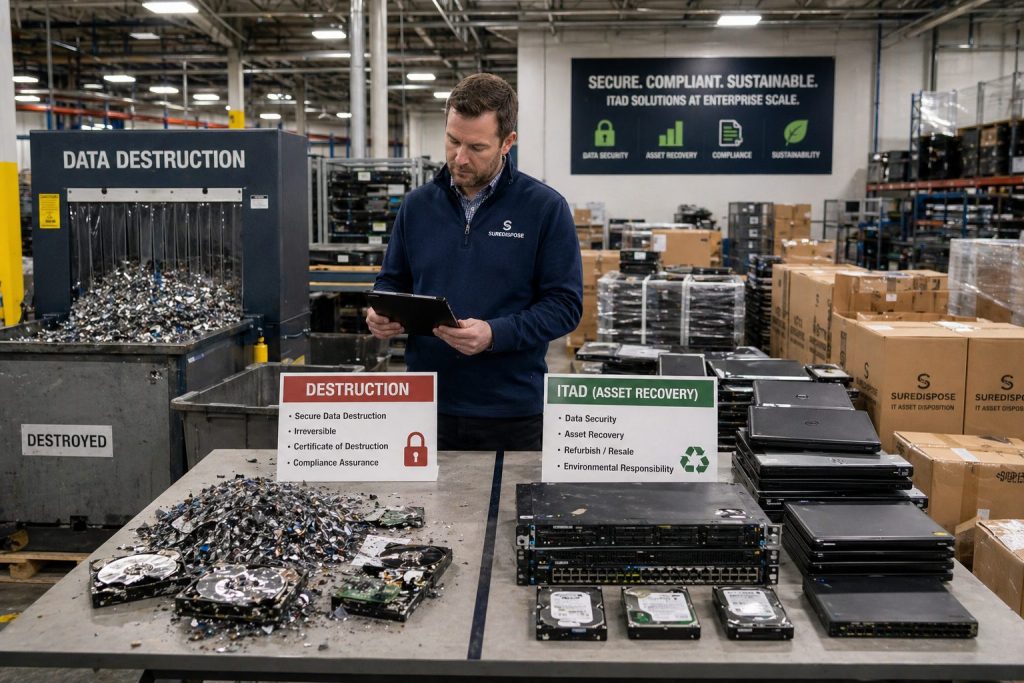
IT asset destruction is the physical destruction of storage media or equipment, typically by shredding, pulverization, or disintegration to specific particle-size standards. The output is unrecoverable material. The deliverable is a Certificate of Destruction tied to the serial numbers that went into the shredder.
ITAD (IT asset disposition) is the broader service category that includes destruction as one of three sanitization paths. Under NIST Special Publication 800-88 Revision 2 (September 2025, the current federal media sanitization standard), the three paths are:
- Clear: standard read/write commands that overwrite user-addressable storage. Suitable for media staying in your environment.
- Purge: logical or physical techniques (cryptographic erase, block erase, degaussing) that render data recovery infeasible even with laboratory tools. Suitable for media leaving your control.
- Destroy: physical destruction. The strongest assurance, and the only option when the media cannot be reliably purged or when policy requires it.
Destruction is one option on a menu. ITAD is the whole menu, plus the logistics, chain of custody, remarketing, recycling, and reporting that wrap around the sanitization decision. A destruction-only vendor processes equipment one way: they shred it. An ITAD vendor decides per device which sanitization path applies, and routes outcomes accordingly.
The price difference reflects this. Destruction-only services are typically priced per device or per pound, with a narrow scope. Full ITAD engagements price logistics, sanitization (usually Clear or Purge as the default with Destroy available), and reporting as a base service, then return some of that cost back through remarketing revenue when retired equipment has resale value.
When Is IT Asset Destruction Enough on Its Own?
Five scenarios where destruction-only is the right standalone call:
1. Classified data or strict regulatory mandate for physical destruction. Some Department of Defense contractors, federal agencies handling Controlled Unclassified Information (CUI), and certain healthcare and financial institutions operate under policies that require physical destruction regardless of whether logical sanitization would be technically sufficient. When the policy says destroy, the destruction service is the answer.
2. Litigation hold release or breach-response cleanup. When equipment is part of a litigation hold and the matter has resolved with a destruction order, or when a breach response requires forensic isolation followed by destruction of the affected drives, the engagement is narrowly scoped to destruction with full chain-of-custody documentation. The remarketing or recycling questions don’t apply.
3. Failed media that cannot be purged. Drives that fail the logical wipe process (bad sectors, failed cryptographic erase, drives that no longer respond to firmware sanitize commands) cannot be reliably purged. NIST 800-88 Rev. 2 expects these to be physically destroyed before leaving your custody. ITAD vendors handle this internally; if your only volume is failed media, a destruction-only engagement is the right scope.
4. Equipment that is already non-functional and has zero resale value. If you’re disposing of CRT monitors from 2009 or laptops with shattered screens and dead batteries, there’s no remarketing revenue to recover. Paying for full ITAD’s settlement, recovery, and reporting infrastructure on equipment with no upside is overspending. Destruction plus R2v3 or e-Stewards certified recycling is the right scope.
5. One-time, low-volume engagements at a single site. Five drives from a closed branch office. A pallet of phones from a discontinued program. The fixed costs of standing up an ITAD program (master service agreement, account management, portal access, multi-site logistics) don’t amortize over that volume. A scheduled destruction service handles it cleanly.
In all five scenarios, the destruction service still needs to be defensible. NAID AAA certification, serial-level Certificates of Destruction, witnessed destruction (in person or via video) for higher-sensitivity loads, and documented chain of custody from your dock to the shredder remain non-negotiable. Destruction-only is a narrower scope, not a lower standard.
Not sure whether your situation calls for destruction-only or full ITAD? Take the free ITAD Readiness Assessment → for a calibrated recommendation based on your asset profile and compliance requirements.
When Do You Need Full ITAD Instead?
Five scenarios where destruction-only leaves money, compliance, or sustainability outcomes on the table:
1. Recurring volume from any kind of refresh cycle. A laptop refresh every three years, a server hardware swap on a four-year cycle, a phone program rolled over annually. Recurring volume creates recurring resale value. Destruction-only on equipment that still has secondary-market value means paying to destroy what you could have paid less to sanitize and remarket.
2. Equipment with current-generation resale value. Recent-generation laptops, servers, networking gear, and accelerators retain meaningful secondary-market value. A modern enterprise SSD or GPU shredded is a multi-hundred-dollar to multi-thousand-dollar write-off per unit. Logical sanitization (Purge under NIST 800-88) is technically sufficient on virtually all of this hardware, defensible to auditors, and preserves the resale value. The economics on full ITAD with remarketing settlement usually favor it strongly over destruction-only on this asset class.
3. Programs with audit, ESG, or sustainability reporting requirements. Full ITAD engagements produce asset reconciliation reports, recycling diversion summaries, downstream processing partner documentation, and (from mature vendors) Scope 3 emissions data tied to device life-extension. Destruction-only services don’t produce most of this. If your program reports to a CISO who tracks chain-of-custody completeness, a CSO who reports to CSRD or SEC climate disclosure rules, or an audit committee that examines disposition controls, the reports are part of the deliverable.
4. Multi-site or geographically distributed programs. Coordinating destruction-only services across 50 retail locations, 200 bank branches, or a remote-employee population is achievable but procurement-heavy. Full ITAD programs build the multi-site logistics, consolidated reporting, and program-level account management around that complexity. The fixed cost is higher; the per-site administrative overhead is much lower.
5. Equipment subject to data privacy obligations under HIPAA, GLBA, FERPA, or state privacy laws. Destruction satisfies the disposition requirement on its own, but most of these regulations also expect documented procedures, validated controls, and reporting that destruction-only vendors don’t produce as part of their default workflow. Full ITAD’s documentation infrastructure exists to survive these audits. Destruction-only puts the documentation burden back on you.
A useful mental model: destruction-only is a tactical service for narrow, urgent, or zero-value scenarios. Full ITAD is a programmatic service for recurring, distributed, or value-bearing equipment. The mismatch is what creates either overspending (destruction on remarketable hardware) or under-protection (logical wipe on hardware that policy required destroyed).
How Do You Combine Destruction and ITAD on a Single Program?
Most enterprise ITAD programs do not pick destruction or full ITAD. They do both, on different equipment, under one engagement.
A typical hybrid scope:
- Default sanitization path: Purge under NIST 800-88 Rev. 2 for all equipment with functioning storage media. Cryptographic erase on self-encrypting drives, block erase or equivalent on standard SSDs and HDDs.
- Destruction triggers: any drive that fails Purge validation, any media classified above a defined threshold (e.g., drives that held PHI, classified data, or regulated financial information), any equipment subject to client-specific destruction policy.
- Witnessed destruction: optional uplift for high-sensitivity loads or compliance-driven engagements (financial services examination preparation, healthcare OCR audit readiness, government CUI handling).
- Remarketing path: equipment that successfully completes Purge validation and has secondary-market value. Settlement returns a percentage of net resale revenue.
- Recycling path: equipment that is destroyed or that completes sanitization but has no resale value. Routed through R2v3 or e-Stewards certified streams.
The vendor decides per device, against rules you set in the SOW. The reporting reconciles the entire engagement: how many units came in, how many were Purged and remarketed, how many were Destroyed, how many were recycled, with serial-level Certificates of Destruction or Sanitization tied to each outcome.
This is the model the vendor-evaluation guide treats as the default for any organization with recurring ITAD volume. The hybrid scope avoids the overspending and under-protection problems on either edge.
Where You Stand Matters
The destruction-vs-ITAD question almost always resolves the same way once the scope is clear: a small subset of your equipment genuinely needs destruction-only, the bulk of recurring volume runs better through full ITAD with destruction available as one of the sanitization paths, and a single hybrid engagement handles both. The mismatched scope is what creates the cost or compliance problem; the unified scope solves it.
The harder question is what mix of destruction and full ITAD your specific environment needs over the next 12 months, calibrated to your asset profile, compliance requirements, and recurring volume. That’s what the assessment is built to surface.
Resources
- NIST SP 800-88 Revision 2 (September 2025): the federal media sanitization standard that defines Clear, Purge, and Destroy as sanitization paths.
- What Is ITAD? A Plain-English Guide to IT Asset Disposition: the foundational walkthrough of what ITAD covers and the four operational stages of a mature program.
- How to Choose an ITAD Vendor: An Evaluation Framework: the certification, sanitization, chain-of-custody, and contract framework for vendor proposals.
- i-SIGMA NAID AAA Certified Member Directory: verify NAID AAA certification on a destruction-only or full-ITAD vendor.
Ready to figure out which scope your environment actually needs? SureDispose’s free assessment evaluates your asset profile, compliance requirements, and operational footprint, then connects you with vetted providers whose service stack matches the scope your situation calls for. Take the Assessment →
SureDispose is an independent advisory platform. We connect organizations with vetted ITAD service providers but do not perform disposition services directly. Providers compensate us for qualified introductions.
This article is educational and reflects SureDispose’s reading of publicly available regulations and industry standards as of April 2026. It is not legal advice. Regulatory determinations for your organization are the responsibility of your compliance counsel. Specific certifications and standards referenced are summarized from publicly available documentation from the issuing body identified.