If you’re comparing IT asset disposition (ITAD) proposals from two or three vendors and the numbers look wildly different, the explanation usually isn’t that one vendor is dramatically cheaper. They’ve scoped different work. ITAD services are typically sold as a bundled core engagement plus a long list of add-ons that get line-itemed only if you specifically request them. This guide explains what’s actually in the base service, what isn’t, and how to read a proposal so the apples-to-apples comparison works.
This is the practical companion to our guide on what ITAD is and why it matters. Once you know what ITAD is, the next question is what an ITAD engagement actually buys you.
What’s Typically Bundled into Base ITAD Services?
Every credible ITAD vendor bundles roughly the same four things into a base scope of work. Anything outside this list is usually priced as an add-on, regardless of how the proposal frames it.
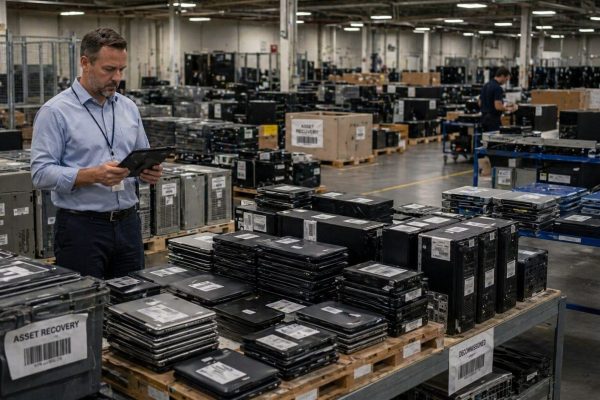
1. Scheduled pickup logistics. A pickup at your dock during business hours, on a date you scheduled in advance, in a vehicle that holds your assets and nothing else. The vendor brings their own pallets or boxes for standard equipment (laptops, desktops, monitors, basic networking gear). Loading is generally yours, or shared. Anything beyond standard business-hours pickup at a single location starts to drift into add-on territory.
2. Serial-level inventory and chain of custody. The vendor logs each unit by serial number on-site at pickup, applies tamper-evident seals to transport containers, and reconciles the manifest at the receiving facility. The chain of custody (the paper trail showing who had your equipment, when, and what they did with it) is part of the base service. A vendor charging extra for serial-level inventory is signaling that their default workflow operates at the bulk-weight manifest level, which is not chain of custody.
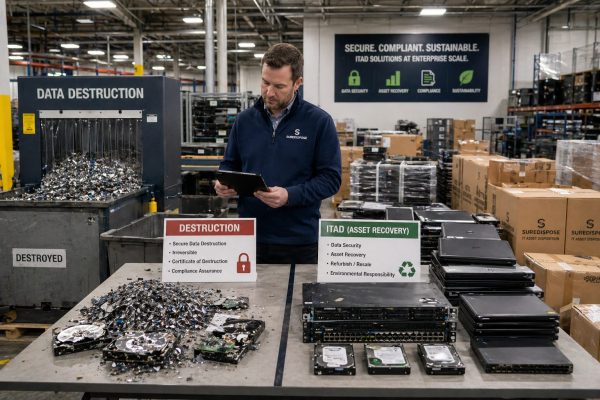
3. Data sanitization to NIST SP 800-88 Rev. 2. Logical sanitization (Clear or Purge methods, depending on media type and policy) on every device with storage media, performed at the vendor’s facility under the September 2025 federal standard. Cryptographic erase on self-encrypting drives is generally bundled. Physical destruction is usually a separate service line; some vendors bundle it for non-functional drives, but most price destruction as an add-on.
4. Recycling and disposal of non-resaleable equipment. What can’t be remarketed gets routed into R2v3 or e-Stewards certified recycling streams. The base SOW typically covers domestic processing and downstream recycling, with the vendor retaining responsibility for downstream environmental compliance.
What you should expect for free with any of these: a serial-level Certificate of Sanitization or Certificate of Destruction, a final asset reconciliation report tying outbound assets to outcomes, and a recycling diversion summary if any equipment was processed environmentally.
What you should not expect for free: anything that involves your vendor coming on-site, anything witnessed, anything specialized, anything that touches data center hardware in a live environment, and almost anything described with the word “white glove.”
Comparing two ITAD proposals and not sure why the numbers differ? Take the free ITAD Readiness Assessment → to generate a scope-and-pricing comparison framework calibrated to your asset profile.
Which ITAD Services Are Almost Always Priced Separately?
The line items below are the most commonly add-on’d parts of an ITAD engagement. None are unusual; all get priced separately on virtually every proposal.
On-site sanitization. A mobile shredder truck or on-site logical wipe operation that sanitizes data before any device leaves your facility. Required for classified data, common in healthcare and financial services, increasingly used by data center operators who don’t want drives out of the building unwiped. Priced per device or per truck-day.
Witnessed destruction. Either a client representative physically present during destruction, or a recorded high-definition video feed retained by the client as evidence of destruction. Common in financial services, where regulators may request proof of destruction during examinations. Priced as a per-engagement uplift.
White-glove logistics. Specialized packaging (anti-static, shock-mitigating), padded transport, and serial-level tracking for high-value or sensitive equipment. Critical for live-environment data center decommissioning, where a single mishandled GPU or AI accelerator can represent five- to six-figure value. Priced per item or per pallet.
Racking and de-racking. Physical removal of equipment from racks, server cabinets, or fixed installations. Standard for data center work; also relevant for telecom node decommissioning and bank-branch equipment removal. Priced per rack-unit or per labor hour.
After-hours and weekend service. Pickups outside standard business hours, common when a site cannot accommodate a daytime disruption. Usually priced as a percentage uplift on the base logistics fee.
Multi-site logistics. Coordinated pickups across multiple locations under a single engagement, with consolidated reporting. Standard ITAD services price each pickup site separately; multi-site bundling sets a per-site rate or volume discount.
Specialized hazardous material handling. Batteries (especially lithium-ion), CRT monitors, mercury-containing equipment, and certain industrial control hardware require RCRA-compliant disposal pathways beyond standard e-waste recycling. Priced per unit and per material category.
Reverse logistics for remote-employee returns. Programmatic collection from distributed employees (return kits, prepaid shipping, individual device intake). Distinct from site-based pickup; priced per kit or per device.
A useful procurement move when comparing proposals: write down which of these line items your environment will need over the next 12 months, ask each vendor to price each one explicitly, and compare the totals rather than the headline base fees. A low base fee paired with high add-on rates can easily come out more expensive than a higher base with bundled add-ons.
How Should the Settlement Side Work When Equipment Has Resale Value?
A meaningful portion of retired IT equipment, particularly recent-generation laptops, servers, and networking gear, retains resale value on the secondary market. Most ITAD providers operate a hybrid commercial model: you pay for sanitization, logistics, and disposal services; the vendor returns a percentage of resale revenue on remarketable equipment. The percentage matters; how it’s calculated matters more.
Revenue share basis. Settlements are generally calculated on net resale revenue (gross sale price minus the vendor’s refurbishment, listing, and remarketing costs) rather than gross. A 70% share of net can be smaller than a 50% share of gross, depending on what the vendor charges back as cost. The proposal should specify exactly which costs come out before the share is calculated.
Pricing methodology. Auction-driven (real market clearing prices) is the most transparent. Dealer-quoted (a fixed per-model price the vendor pays you, then resells for whatever they can get) is the easiest to administer but obscures actual market value. Tiered fixed pricing (predetermined per-condition-grade pricing the vendor publishes upfront) is a middle ground and works well for high-volume commodity hardware.
Audit rights and timing. Your contract should give you the right to audit settlement calculations on request, including the underlying sale records that support each remarketing transaction. A vendor who pushes back on audit rights is signaling that the math isn’t intended to be checked. Settlement payments typically run 60–90 days behind the date assets entered the remarketing channel, reflecting refurbishment, listing, and sale time. Settlements that run 120+ days are worth a question; settlements that run 30 days are unusually fast and worth a different question.
Floor pricing. For higher-volume programs, some vendors will commit to minimum per-unit settlement amounts on common hardware classes regardless of resale outcome. This shifts market risk from you to the vendor and is worth negotiating into a multi-year program.
Want a benchmark on what settlement terms look like for your asset profile? Take the free ITAD Readiness Assessment →.
What Reports and Documentation Should the Engagement Produce?
Reports are the deliverable. Without them, the rest of the work is invisible to your auditors. A serious engagement produces, at minimum:
A serial-level Certificate of Sanitization or Certificate of Destruction. One per device, tied to its serial number, specifying the sanitization method (Clear, Purge, or Destroy under NIST 800-88 Rev. 2), the date, the operator, and the outcome. Batch-level certificates have limited audit value; insist on serial-level.
A final asset reconciliation report. Reconciles the inventory you handed over at pickup against final disposition outcomes for each unit: sanitized and remarketed, sanitized and recycled, physically destroyed, or held back. Total in equals total out, with every exception documented.
A recycling and environmental diversion summary. Total weight processed, percentage diverted from landfill, downstream processing partners (with their certifications), and any specific commodity recovery numbers (rare-earth metals, copper, plastics) if the vendor produces them. Required for ESG reporting in many programs.
A remarketing settlement statement. For any equipment that entered the remarketing channel, a per-unit record showing sale date, channel, gross price, costs deducted, net revenue, and your share. Reconciles to the final payment.
Increasingly requested by enterprise programs subject to CSRD or SEC climate disclosure rules: ESG and Scope 3 emissions data covering carbon avoided through device life-extension, donation, and reuse. Available from vendors with mature sustainability reporting; less common from regional operators.
A vendor whose proposal does not specify the report deliverables, or who treats reporting as a “we’ll send something at the end” line, is signaling that reporting isn’t part of their default workflow. For any compliance-sensitive program, that’s a fit issue.
Where You Stand Matters
The proposal-comparison problem solves itself once you know what to ask for. Define the scope your environment needs (base ITAD services plus the specific add-ons your assets require), require each vendor to price each line item explicitly, and require the reporting deliverables your auditors will actually look at. Differences between proposals usually shrink considerably once everyone is pricing the same scope.
The harder question, which provider’s certification stack, footprint, and settlement model fit your organization, is what the assessment is built for. The five-minute version is faster than reading three proposals.
Resources
- NIST SP 800-88 Revision 2 (September 2025): the federal media sanitization standard ITAD services should map to.
- What Is ITAD? A Plain-English Guide to IT Asset Disposition: the parent pillar covering what ITAD is and the lifecycle conceptually.
- How to Choose an ITAD Vendor: An Evaluation Framework: the certification, sanitization, chain-of-custody, and contract framework for evaluating vendor proposals.
Ready to compare ITAD proposals against a calibrated scope? SureDispose’s free assessment generates a scope-and-pricing comparison framework based on your asset profile, compliance requirements, and operational footprint, then connects you with vetted providers whose service stack fits your actual needs. Take the Assessment →
SureDispose is an independent advisory platform. We connect organizations with vetted ITAD service providers but do not perform disposition services directly. Providers compensate us for qualified introductions.
This article is educational and reflects SureDispose’s reading of publicly available regulations, industry standards, and procurement practices as of April 2026. It is not legal advice. Regulatory determinations for your organization are the responsibility of your compliance counsel. Specific certifications, standards, and procurement frameworks referenced are summarized from publicly available documentation from the issuing body identified.