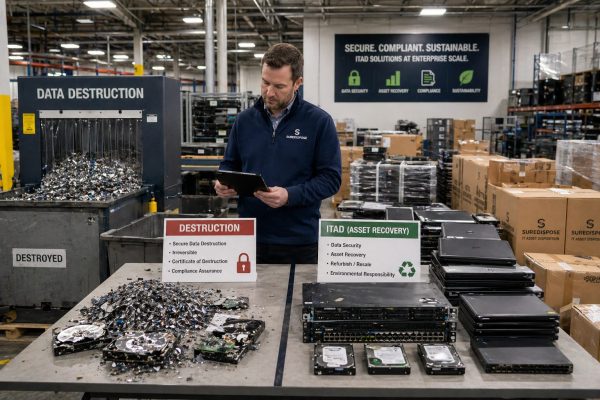
A Certificate of Recycling used to be enough. Sustainability officers would drop it in a folder, reference the vendor’s zero-landfill pledge in the annual CSR report, and move on. That era is over. Investors, regulators, and audit committees now want emission factors, diversion tonnages traceable to a specific facility, and a credible line of sight from retired hardware to the number your CFO signs in the 10-K.
ITAD ESG sustainability reporting is where that line-of-sight gets built — or exposed as fiction. This guide explains how disposition actually affects Scope 3 emissions, which circular-economy metrics a vendor should be delivering, what CSRD, SEC, and CDP disclosures require from end-of-life IT, and how to separate defensible data from greenwashing before it lands in a disclosure document.
How Does ITAD Actually Contribute to Scope 3 Emission Reductions?
IT asset disposition (ITAD) is the formal, auditable process of retiring equipment from production — data sanitization, chain-of-custody documentation, and a terminal outcome (resale, donation, or destruction). Its ESG footprint is dominated by a single decision: whether a device gets a second productive life or gets shredded for base material recovery.
The emissions math is not close. Empirical analysis indicates that an ITAD methodology heavily weighted toward reuse and refurbishment prevents approximately 29.83 metric tons of CO2-equivalent emissions per ton of laptops processed. Traditional physical recycling, by comparison, offsets roughly 1.07 metric tons of CO2e per ton — the energy-intensive processes of smelting, pulverization, and chemical extraction consume most of the carbon benefit on the way to recovering base metals. Put simply, reuse avoids nearly 28 times more carbon per unit of mass than destructive recycling does.
For enterprise buyers, the relevant Scope 3 category under the GHG Protocol is Category 5 — Waste Generated in Operations, which covers emissions from the disposal of your own operational waste including retired IT assets. Manufacturers and OEMs additionally account for Category 12 — End-of-Life Treatment of Sold Products, which covers the downstream disposition of products they sold. Enterprises with DaaS or leased-fleet structures may see category attribution shift depending on ownership of the asset at end-of-life; the answer depends on contract terms, not a default.
Within Category 5, the emission factor difference between “landfilled” and “recycled with recovery” is substantial — but the difference between “recycled” and “reused” is an order of magnitude larger. That is the number ITAD ESG sustainability strategy pivots on. A single reused laptop avoids roughly 300 kilograms of CO2e associated with manufacturing its replacement — equivalent to taking a passenger car off the road for several weeks. A national medical services company documented 219,775 kilograms of CO2e avoided through asset reuse in a single engagement, with net emission reduction of 221,330 kg even after accounting for logistics emissions. These are the claims that survive audit. Generic “we are environmentally responsible” statements are the ones that get cut.
What Circular Economy Metrics Should Your ITAD Vendor Deliver?
“Zero-landfill” is not a metric. It is a marketing phrase that can sit on top of vastly different underlying operational realities. Audit-ready circular-economy reporting requires five specific quantitative outputs from your ITAD vendor, traceable to specific facilities and specific engagement volumes.
Reuse rate. The percentage of received units that are tested, sanitized, and returned to productive use through resale or donation — not shredded for material recovery. Publicly traded enterprise ITAD operators servicing hyperscale clients routinely report reuse rates between 86% and 96% on recovered assets. Vendors without Responsible Recycling (R2v3) or e-Stewards certification are not contractually bound to the “Reuse First” hierarchy those standards enforce, and their reuse rates can be materially lower without being reported.
Landfill diversion rate. The percentage by weight of material that is kept out of landfill — diverted to reuse, component recovery, or certified downstream material recovery streams. Credible operators report 99%+ diversion on processed volume. Anything below that should trigger a question about downstream chain of custody.
Material recovery mass. Weight of specific commodity streams reclaimed — gold, copper, aluminum, steel, rare earth elements, recovered plastics. This is where the circular-economy narrative becomes quantitative. A hyperscaler-grade ITAD engagement will deliver tonnage by commodity, not just an aggregate diversion percentage.
Avoided CO2e emissions. Estimated carbon emissions avoided through reuse versus virgin-material replacement, expressed in metric tons CO2e. Good vendors use emission factors sourced from peer-reviewed life-cycle analyses and cite their methodology. Very good vendors let you select the emission factor source to align with your corporate methodology.
Downstream chain of custody. Documentation of which specific downstream partners received which material streams, under which certifications, and verified by which audits. This is the metric that separates credible sustainability reporting from theater. A vendor unable to name their downstream partners cannot give you defensible ESG data; they can only give you a narrative.
A usable vendor scorecard asks for all five, reported per engagement, with methodology notes. Anything less is narrative reporting dressed up as environmental data — and the gap between real ITAD ESG sustainability data and vendor marketing is exactly the gap that shows up under audit.
Wondering whether your current ITAD reporting would survive an ESG audit? Take the free ITAD Readiness Assessment →
What Do CSRD, SEC, and CDP Disclosures Require for End-of-Life IT?
The reporting regimes that ingest ITAD data have tightened substantially. Sustainability reports that would have passed as good-faith effort five years ago are now subject to specific disclosure frameworks with audit requirements attached.
Corporate Sustainability Reporting Directive (CSRD) — European Union. The CSRD requires in-scope organizations to report on a detailed set of ESG metrics under the European Sustainability Reporting Standards (ESRS). Scope 3 emissions disclosure, including waste-related categories, is expected where material. Limited assurance is required, with reasonable assurance on the horizon. Vendor data quality matters because the reporting organization’s auditor will sample it.
SEC Climate Disclosure — United States. The SEC’s climate-related disclosure rule, adopted in 2024, was subsequently stayed and is now subject to ongoing litigation and the current administration’s March 2025 decision to end its defense of the rule. The enforceability and final form remain unsettled. Nonetheless, many large US-listed enterprises voluntarily report Scope 3 emissions through CDP and other channels because investors and lenders are asking for them — and because European operations often remain in CSRD scope regardless of SEC status.
CDP disclosure. CDP (formerly the Carbon Disclosure Project) runs the largest voluntary environmental disclosure system globally. Its climate-change questionnaire asks for Scope 3 emissions by category where relevant, with methodology detail and third-party verification status. Weak or untraceable ITAD data shows up on CDP reports as low scores, and those scores are visible to institutional investors.
GRI Standards. The Global Reporting Initiative’s GRI 306 (Waste) standard asks organizations to disclose waste generated, waste diverted from disposal, and waste directed to disposal — broken down by waste composition and treatment method. Retired IT equipment falls inside this standard for most in-scope reporters.
California SB 253 and SB 261. California’s climate disclosure laws require large companies doing business in the state to report greenhouse gas emissions (SB 253) and climate-related financial risk (SB 261), phasing in from 2026 onward. SB 253 specifically requires Scope 3 reporting beginning 2027 for covered entities. ITAD data feeds Scope 3 Category 5 or Category 12 depending on the reporting entity’s role.
EU Waste Electrical and Electronic Equipment (WEEE) Directive and Basel Convention amendments. The January 2025 Basel Convention amendments extended Prior Informed Consent procedures to all electrical and electronic waste crossing borders — hazardous or non-hazardous. Enterprises exporting any e-waste must now document consent and tracking across each jurisdictional boundary. ITAD vendors without robust downstream audit processes cannot provide the documentation chain regulators expect.
The practical takeaway: ITAD ESG sustainability data is no longer a sidebar to corporate ESG reporting. It is a primary input into Scope 3 accounting, a regulated disclosure in multiple jurisdictions, and an auditable line item that investors increasingly examine. Vendor selection and documentation practices have to match.
Uncertain whether your vendor’s data will hold up under CSRD or CDP scrutiny? Take the free ITAD Readiness Assessment →
How Do You Separate Real ITAD ESG Sustainability Metrics From Greenwashing?
Greenwashing in ITAD is rarely outright fabrication. It is more often selective reporting — the parts of the process with good numbers are published, the parts without traceable documentation are elided, and the aggregate claim reads better than the underlying data supports. Credible ITAD ESG sustainability reporting does the opposite: it surfaces the numbers that do not flatter, acknowledges the uncertainty, and documents methodology openly. Sophisticated reviewers know the patterns. The following six questions expose most of them.
Can the vendor name every downstream recipient of each material stream? Reuse partners, material recovery facilities, smelters, plastics processors — by company name, facility location, and audit status. A vendor that responds with “we work with certified downstream partners” without naming them is telling you the chain of custody stops at their loading dock. Your ESG reporting inherits that visibility gap.
Are R2v3 or e-Stewards certifications current, and do they cover the specific facility handling your material? Certifications are facility-specific. A vendor with one R2v3-certified flagship and three non-certified satellite locations can legitimately claim R2v3 certification — while processing your material at an uncertified site. Ask which facility processes which volume and confirm certification applies there.
What is the methodology behind the CO2e number? Emission factors come from a limited number of published sources. Credible reporting cites the source (EPA WARM model, ecoinvent database, supplier-specific data, peer-reviewed LCA). Reports that present a CO2e total without methodology notes are conclusions, not data.
Does reported reuse rate match observable outcomes? If a vendor claims a 95% reuse rate but their facility’s public photos show industrial shredding equipment as the primary operational footprint, those numbers are not aligned. Ask for a sample engagement report — volume received, volume refurbished and sold, volume recycled, volume landfilled. Real numbers have variance. Numbers that always end in round percentages usually are not measured, they are estimated.
Are diversion claims audited, and by whom? Third-party audit of operational data is the line between self-reporting and assurance. R2v3 and e-Stewards both require surveillance audits. ISO 14001 (environmental management) adds another layer. Vendors that hold these certifications have external auditors examining their reuse and diversion data on a regular cycle. Vendors that don’t, don’t.
How does the vendor handle the asset that cannot be traced? Some percentage of received material — damaged, obsolete, contaminated — will not map cleanly to a downstream partner. Credible vendors account for it transparently: “X% of received mass was processed through licensed hazardous-waste streams with certificates attached.” Vendors that imply 100% material recovery are describing marketing, not operations.
A vendor that answers these six questions with specifics and documentation is a partner your sustainability team can publish numbers from. A vendor that answers with reassurance and generalities is a risk that belongs in your ESG risk register, not your annual report.
Want to benchmark your vendor’s ESG reporting against audit-ready standards? Take the free ITAD Readiness Assessment →
Where You Stand Matters
The gap between credible ITAD ESG sustainability reporting and the comfortable fiction of “we recycle everything” has widened fast. Five years ago, the question was whether to publish circular-economy metrics at all. Today the question is whether the metrics you publish will survive a limited-assurance audit under CSRD, a sampling exercise from a CDP investor-signatory, or a regulatory inquiry under a state climate disclosure law.
The organizations getting this right are not the ones with the most polished sustainability web page. They are the ones whose ITAD program generates documentation traceable to specific facilities, specific certifications, and specific downstream partners — and whose vendor relationships include the contractual right to audit that documentation. Everything else is storytelling, and storytelling does not reconcile to a 10-K.
That is the strategic framing sustainability leaders, CIOs with sustainability-linked OKRs, and ESG officers should be taking into ITAD vendor evaluations. The metrics you get out of the program in 2030 are determined by the contracts and certification standards you put into it in 2026.
Ready to assess your organization’s ITAD readiness? SureDispose’s free assessment evaluates your current practices across data security, compliance, and ESG-reporting dimensions — and connects you with certified providers matched to your requirements. Take the Assessment →
Further reading:
- GHG Protocol Scope 3 Standard (Categories 5 and 12)
- R2v3 Standard for Responsible Recycling
- GRI 306: Waste Standard
- CDP Climate Change Disclosure
SureDispose is an independent advisory platform. We connect organizations with vetted ITAD service providers but do not perform disposition services directly. Providers compensate us for qualified introductions.
This article is educational. It summarizes publicly available regulatory frameworks, industry standards, and market data as of April 2026 and does not constitute legal, tax, or sustainability-assurance advice. ESG disclosure requirements and their applicability to specific organizations depend on jurisdiction, size thresholds, and sector — and both regulations and assurance standards continue to evolve. Disclosure decisions for your organization should be made in consultation with qualified counsel, auditors, and your ITAD vendor.