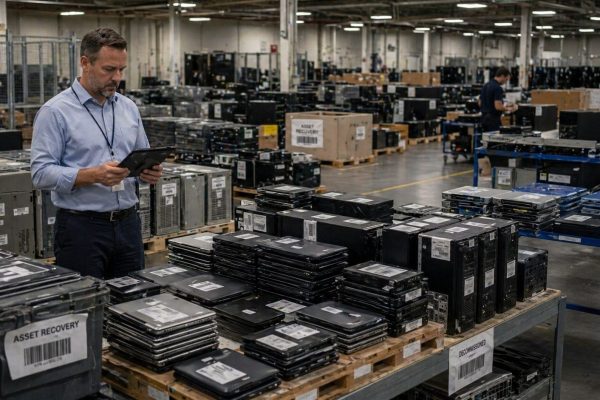
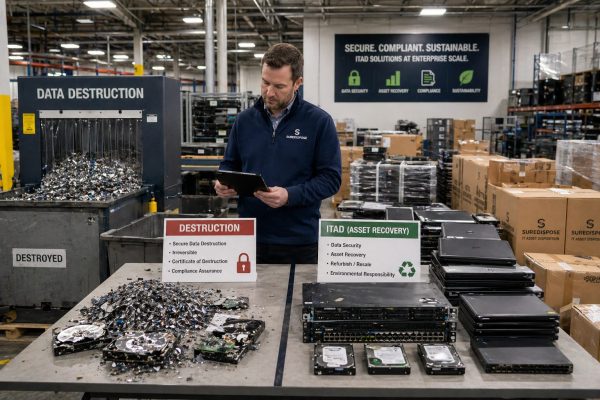
Retired IT equipment does not have a single, obvious dollar value. The same three-year-old laptop can yield $340 on a retail refurbished marketplace, $180 on a wholesale buyout, $0 at a social-enterprise donation partner, or a negative $12 after recycling fees — depending entirely on how you route it and who processes it. That gap between outcomes is the entire subject of ITAD value recovery, and it is the reason finance leaders and IT directors are being asked to treat disposition as a portfolio problem, not a janitorial one.
This guide explains what drives secondary-market pricing, how the two dominant financial models differ, what typical recovery rates look like by device category, and when equipment genuinely costs more to dispose of than it can possibly return. If you are building a business case for ITAD — or defending the one you already run — this is the economic backbone underneath it.
What Is ITAD Value Recovery, and What Drives Secondary-Market Pricing?
IT asset disposition (ITAD) is the formal, auditable process of retiring equipment from production — typically involving data sanitization, chain-of-custody documentation, and a terminal outcome (resale, donation, or destruction). ITAD value recovery is the financial subset of that process: the revenue an organization captures when retired assets are remarketed into the secondary market rather than shredded.
Four variables move the price on any given asset:
Age and platform maturity. Enterprise servers retain useful economic life for roughly 5 to 7 years; corporate laptops depreciate on a much steeper curve and typically exit their peak remarketing window between years three and four. The reason servers age more gracefully is simple: new CPU generations deliver smaller performance-per-watt gains than they did a decade ago, which keeps legacy Dell Gen14 and HPE Gen10 chassis usable well past their initial amortization period.
Cosmetic grade. The secondary market runs on a standardized Grade A/B/C/D rubric. A Grade A device — zero dents, no visible screen damage, minimal keyboard wear — can yield 20% to 40% more revenue than a functionally identical Grade B unit. Grading is not cosmetic vanity; it is the variable that determines which sales channel the asset can access. Grade A assets qualify for premium retail marketplaces (Amazon Renewed, Back Market). Grade C assets route to wholesale or geographic-arbitrage export.
Component demand. The AI infrastructure boom has consumed global supply of new high-bandwidth memory and high-speed DRAM, which has unexpectedly raised the resale value of DDR4 modules harvested from hyperscale decommissioning projects. Publicly traded ITAD operators including Iron Mountain and Sims Lifecycle Services have cited DDR4 recovery as a primary growth engine. Component-level pricing moves fast; whole-system pricing moves more slowly. A competent ITAD vendor tracks both.
Channel access. The top of the margin stack sits in direct-to-consumer retail platforms. Amazon Renewed requires ITAD sellers to maintain an Order Defect Rate of 0.8% or less and to demonstrate at least $50,000 in qualifying refurbished-goods purchases within a 90-day window before they can list. Back Market evaluates sellers against 25 operational metrics enforced by mystery orders and charges a Quality Assurance Fee on every transaction. Not every ITAD vendor qualifies. Those who do extract materially higher margins on A-Grade and B-Grade assets than wholesale-only operators can.
Put those four variables together and you get the basic answer to “what is this worth?” — age and cosmetic grade set the range, component demand shifts the ceiling, and channel access determines how much of the ceiling the asset can actually touch.
Wondering whether your refresh cycles are capturing peak remarketing value? Take the free ITAD Readiness Assessment →
How Do Revenue-Share and Direct-Buyout Models Compare?
ITAD vendors engage enterprise clients under two dominant commercial structures. The choice between them is not a preference question. It is a question about who bears market risk and who captures upside.
Direct purchase (buyout). The vendor buys the retired fleet outright for a fixed cash sum and absorbs all downstream risk — market volatility, testing yield, cosmetic-grade surprises, inventory holding costs. Because the vendor bears that risk, buyout offers are typically discounted 20% to 40% below projected secondary-market value. The appeal is clean: you receive predictable cash at pickup, your financial liability terminates on the day assets leave your dock, and you never have to track a line item through resale.
Revenue share (consignment). The vendor processes, sanitizes, refurbishes, and remarkets assets, then splits net proceeds with you on a pre-negotiated ratio — typically 60/40 to 70/30 in the enterprise’s favor on net revenue after processing fees. Because the vendor’s profit tracks final sale price, the economic incentives align: both parties want the asset in the highest-yielding channel. Published industry data puts revenue-share outcomes 20% to 40% above comparable buyout deals — but you wait until point of sale to see the cash, and some proportion of units will fail testing and contribute nothing.
A third, narrower model exists for high-security environments: fee-for-service, where you pay a flat per-unit processing fee and retain 100% of any resale revenue. This is common for classified or highly sensitive hardware where the vendor’s market-making role is not wanted — security dominates the decision and value recovery is secondary.
The right model depends on three questions your finance team should answer before the first RFP:
- How much cash-flow predictability does the budget cycle require?
- How much volatility tolerance do you have on the disposition line?
- How many quarters can you wait between pickup and settlement?
Organizations with predictable refresh cycles, patient finance teams, and high-volume Grade A fleets generally recover more under revenue share. Organizations with unpredictable decommissioning events, tight cash-flow planning, or older fleets often prefer the certainty of buyout.
What Can You Actually Recover by Device Category?
Recovery rates vary more by category than most budgets assume. Treating “IT refresh” as a single disposition line item is a common source of forecast error.
Corporate laptops and ultrabooks (3 to 4 years old, Grade A/B). This is the sweet spot of enterprise remarketing. Well-maintained business-class laptops — ThinkPads, Latitudes, EliteBooks, MacBook Pros — consistently retain 15% to 30% of original purchase price in the three-to-four-year window, with MacBooks at the top end due to stronger secondary demand and the Apple Trade In program’s aggressive pricing structure.
Servers and data-center hardware (3 to 5 years old). Whole-system resale is highly sensitive to generation and configuration. A well-specified Dell R740xd or HPE DL380 Gen10 can retain meaningful value into year five. Component harvesting — CPUs, DDR4 memory, NVMe SSDs — often exceeds whole-system resale value when configurations are non-standard or chassis are damaged.
iPads and premium tablets. Apple’s market dominance in tablet refurbished sales produces predictable curves. Industry consensus puts optimal trade-in windows at roughly three years for iPads, with strong residual value through manufacturer programs and third-party refurbishers.
Chromebooks (K-12 and mass-deployment fleets). Secondary-market economics here are weak. Four-to-five-year-old school Chromebooks typically yield $30 to $100 per unit in pristine condition, and Chromebooks past their Automatic Update Expiration (AUE) date often yield zero because they cannot be securely repurposed. Specialized ITAD programs aggregate these marginal values across tens of thousands of units to produce meaningful bulk credits — but the per-unit math is fundamentally different from enterprise laptops.
Desktops and all-in-ones. Depreciation is steep. Standard business desktops lose most of their resale value by year four, and form-factor declines in desktop demand make whole-system resale difficult. Component harvesting and domestic business-to-business refurbished channels still produce returns for Grade A units.
Monitors, peripherals, and networking gear. Value per unit is low but volume can matter. Monitors larger than 24 inches, enterprise-grade docking stations, and Cisco/Juniper networking gear all retain modest secondary value. Anything smaller than a 22-inch monitor typically recovers less than its processing cost.
The correct frame for CFO conversations is not “we recovered X% of purchase price.” It is “we recovered X% of purchase price on the top two categories, which represent 80% of our disposal volume, and absorbed a small net cost on the remaining categories.” That’s the conversation value-recovery math actually supports.
Not sure which of your categories justify revenue share vs. buyout? Take the free ITAD Readiness Assessment →
When Does Equipment Have Negative Disposal Value?
Some retired assets cost more to responsibly dispose of than they can possibly recover. Pretending otherwise distorts budget forecasts and invites worse outcomes downstream.
Negative-value scenarios cluster in five categories:
Post-AUE Chromebooks and EOL mass-deployment fleets. Once secure firmware updates end, the device cannot be repurposed for consumer use. Responsible recycling generates a cost. Industry pricing indicates that post-AUE Chromebooks often yield zero resale revenue and incur a per-unit recycling fee.
Hazardous-material components. Swollen lithium-ion batteries, damaged CRT monitors, and logic boards contaminated by coolant leaks carry compliance costs that exceed any recoverable value. These assets require hazardous-waste handling, and the fees are non-negotiable.
Severely damaged whole systems. Equipment with cracked screens, liquid damage, or chassis cracks larger than the cosmetic-grade tolerance often drops to Grade D — where the whole-system resale channel closes and the value depends entirely on component harvest yield. When harvest yield is low (proprietary motherboard designs, soldered RAM, non-standard connectors), the processing fees to test and extract individual parts exceed the revenue those parts recover.
Very old or obscure equipment. Assets older than 7 to 8 years — unless they are collectible, parts-harvest candidates, or specialty gear with active niche demand — typically lack a functioning secondary market. Standardized processing fees still apply. The math does not work.
Classified or security-destroyed media. When an asset must be physically shredded to meet NIST SP 800-88 Rev. 2 (September 2025) standards for Purge or Destroy — or stricter classified-destruction specifications — whole-system resale is structurally impossible. You are paying for secure destruction, not recovering value. This is a design feature of the compliance regime, not a failure of the ITAD program.
The practical implication: every ITAD disposition event contains a mix of positive-value assets, zero-value assets, and negative-value assets. A vendor that quotes a single aggregate “recovery rate” without categorizing the portfolio is either simplifying for sales purposes or not looking at the actual fleet. Ask for category-level estimates before you sign.
Want to benchmark your current recovery rates against category norms? Take the free ITAD Readiness Assessment →
Where ITAD Value Recovery Fits in Your Broader Lifecycle Strategy
ITAD value recovery is a real line item. Iron Mountain’s Asset Lifecycle Management segment reported a 65% year-over-year revenue increase to $169 million in a single quarter; that is the visible edge of a secondary market that has matured into a significant corporate finance lever. For enterprises processing tens of thousands of assets annually, properly structured value recovery can offset 30% to 60% of refresh-cycle capital expenditure — with wide variance depending on fleet composition, refresh timing, and channel access.
But value recovery is one objective among several, and it is not always the dominant one. Data-security-intensive environments will correctly choose destruction over resale even when the economics favor resale. Organizations with strong social-enterprise donation partnerships may prioritize community-impact outcomes and accept lower financial recovery in exchange for tax-deductible donation receipts and digital-equity impact. Regulatory environments (government surplus property, healthcare Protected Health Information disposition) impose disposition hierarchies that override pure financial optimization.
The right question is not “how do I maximize ITAD value recovery?” It is “what mix of recovery, security, and stewardship outcomes does my organization need, and which vendor and commercial structure delivers that mix efficiently?”
Answering that requires honest inventory — what categories make up your fleet, what refresh cadence drives your volume, what regulatory posture you must maintain, and what level of cash-flow volatility your finance team will accept. The organizations that extract the most value from ITAD are not the ones with the best vendors. They are the ones that framed the question correctly before the vendor conversation started.
Ready to assess your organization’s ITAD readiness? SureDispose’s free assessment evaluates your current practices across data security, compliance, and value-recovery dimensions — and connects you with certified providers matched to your requirements. Take the Assessment →
Further reading:
- NIST SP 800-88 Rev. 2 (September 2025): Guidelines for Media Sanitization
- GHG Protocol Scope 3 Standard (Categories 5 and 12)
- R2v3 Standard for Responsible Recycling
- EPA: Sustainable Management of Electronics
SureDispose is an independent advisory platform. We connect organizations with vetted ITAD service providers but do not perform disposition services directly. Providers compensate us for qualified introductions.
This article is educational. It summarizes publicly available industry research, regulatory standards, and market data as of April 2026 and does not constitute legal, financial, or tax advice. Secondary-market pricing, certification requirements, and regulatory treatment vary by jurisdiction and change over time; specific disposition decisions for your organization should be made in consultation with qualified counsel and your ITAD vendor. References to named providers reflect publicly reported company data and are not endorsements.