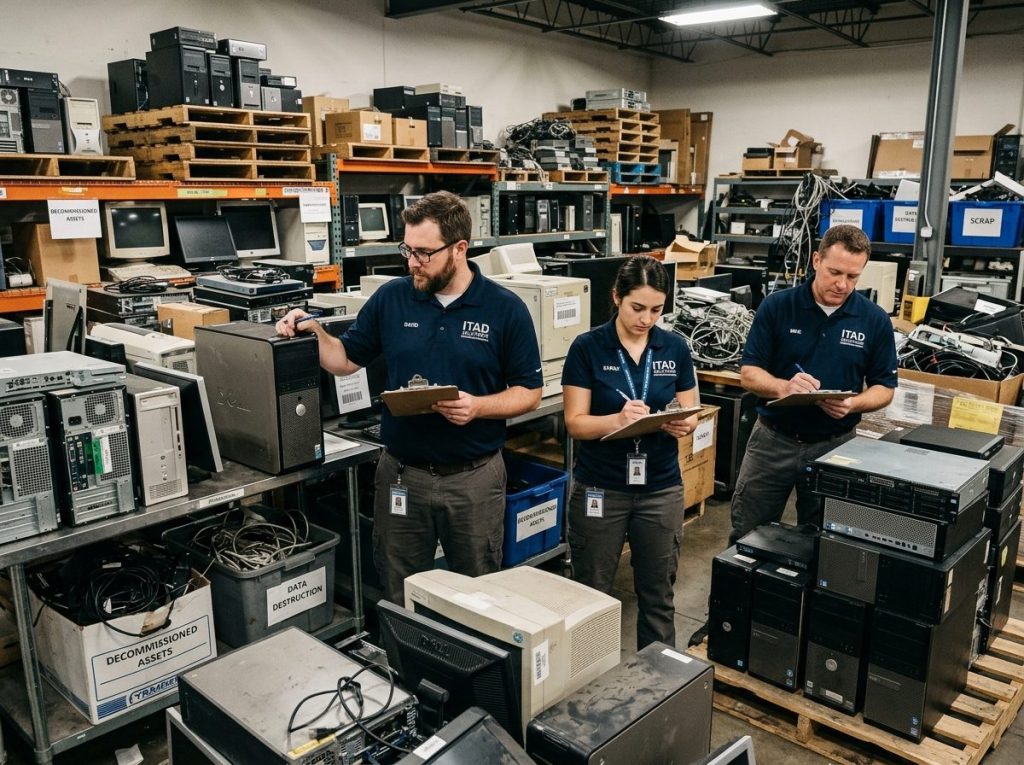
Why Corporate Data Destruction Is the Part of Business ITAD That Keeps Getting Skipped
Every business upgrades its technology eventually. New laptops roll in, old ones get stacked in a closet, and someone says “we will deal with those later.” Later turns into months. Months turn into a forgotten pile of hardware with live data on it. This is not a hypothetical scenario, it is the most common pattern in corporate IT departments of every size.
Corporate data destruction is the step that separates a defensible business ITAD program from a liability that compounds over time. When companies skip it, or do it badly, the cost shows up eventually. Sometimes it is a breach. Sometimes it is a failed audit. Sometimes it is the realization that hardware worth tens of thousands of dollars in remarketing value sat in a closet until it was worthless. The question is never whether the cost shows up. The question is when and how badly.
What Does NIST SP 800-88 Rev. 2 Mean for Corporate Data Destruction?
NIST SP 800-88 Rev. 2, finalized in September 2025, is the standard that auditors, regulators, and courts reference when evaluating whether a company’s data destruction practices are “reasonable.” Even though NIST is a federal publication aimed at government agencies, it has become the de facto benchmark for private sector businesses as well. The 2025 revision made two changes that matter for corporate environments.
First, it shifted the focus from individual wipe events to establishing a documented sanitization program. That means a one off wipe is no longer enough, you need a repeatable process with policies, procedures, and validation. Second, it specifically acknowledged that standard overwrite procedures do not adequately sanitize SSDs, NVMe drives, and embedded flash media. If your company has been treating solid state drives the same way it treated spinning hard drives five years ago, the data on those drives may still be recoverable despite your “wipe.” You can read the full guideline at the NIST Computer Security Resource Center.
How Do You Match Sanitization Method to Data Sensitivity?
NIST defines three levels: Clear, Purge, and Destroy. Clear uses logical techniques (like overwriting) to make data infeasible to recover using standard data recovery tools. This works for lower sensitivity data on magnetic hard drives. Purge uses more advanced methods, including cryptographic erase and block erase for SSDs, that make data infeasible to recover even with laboratory grade techniques.
This is appropriate for most corporate data, including customer PII, employee records, and financial information. Destroy physically renders the media unusable through shredding, disintegration, or incineration, and is reserved for high sensitivity data or situations where the media cannot be reliably purged (some older SSDs, embedded flash in networking equipment, and damaged drives where software sanitization cannot be verified). The key decision point is the highest data sensitivity that ever lived on the device. A laptop that processed customer payment data once gets classified based on that payment data, not on the fact that it was mostly used for email.
Why Don’t Standard Overwrites Work for SSDs and Flash Media?
SSDs store data differently than magnetic hard drives. Magnetic drives write data to predictable physical locations on spinning platters, and an overwrite can reliably replace every bit. SSDs use flash memory cells with wear leveling algorithms that distribute writes across the drive to extend its lifespan. That means when you “overwrite” an SSD, the drive’s controller may write the new data to different cells while leaving the original data intact in cells that are no longer actively mapped. Over provisioned space (extra capacity the drive reserves internally) can also retain data that overwrite tools never touch.
The result: a standard overwrite on an SSD may look successful, but forensic tools can still recover data from unmapped cells. NIST SP 800-88 Rev. 2 addressed this directly by recommending compliance with IEEE 2883 for solid state media sanitization, which specifies methods designed for the way SSDs actually work. For corporate environments, the practical takeaway is that any business ITAD program must treat SSDs and flash media as a separate category with specific sanitization requirements.
How Do You Build a Corporate Data Destruction Program From Scratch?
Five steps. First, inventory your retired assets. Walk every office, closet, and warehouse and count every device that has come out of service. Classify each one by the highest data sensitivity it ever processed. Second, write a policy. Document your sanitization methods mapped to data sensitivity (Clear for low, Purge for moderate, Destroy for high), assign roles, and define the workflow from desk to final disposition. Third, select the right tools. For software sanitization, tools like Blancco Drive Eraser generate tamper proof certificates that meet NIST 800-88 Rev. 2 requirements.
For physical destruction, use a vendor with NSA EPL listed shredders or NAID AAA certified destruction services. Fourth, validate. The new NIST standard explicitly calls for sanitization validation, meaning you confirm the wipe or destruction actually worked, not just that the process ran. Fifth, document everything at the serial number level: device identifier, data classification, sanitization method, validation result, operator, date, and final disposition (remarketed, recycled, or destroyed).
What Happens When Companies Skip This Step?
The cost always shows up. In breach form: customer records surface from a resold drive, and the company faces notification costs, regulatory fines, and lawsuits. Under the CCPA alone, consumers can pursue $100 to $750 per incident in statutory damages, and with thousands of records on a single drive, that exposure scales fast. In audit form: a SOX auditor flags the lack of data disposal controls, or a PCI DSS assessment finds cardholder data on retired terminals that were “recycled” without verification. In value recovery form: hardware that was worth $30,000 in remarketing value six months ago depreciates to near zero while it sits in a closet, turning a recoverable asset into e-waste. IBM’s 2025 Cost of a Data Breach Report puts the global average breach cost at $4.44 million, and U.S. breaches at $10.22 million. The cost of a proper business ITAD program is a fraction of any one of those outcomes.
So What Is the Real Cost of Skipping a Proper Business ITAD Program?
It is always more than the program itself would have cost. Breach costs average $4.44 million globally and $10.22 million in the United States. CCPA violations run $2,500 to $7,500 per record. PCI DSS noncompliance can trigger fines from your payment processor and card brands. SOX control weaknesses make it into audit reports that move markets.
And every month hardware sits in a closet, its remarketing value drops. The cost of skipping a proper business ITAD program always shows up eventually, whether through a breach, a failed audit, or lost asset value, and it is never cheaper than doing it right. Build your program around NIST SP 800-88 Rev. 2. Match sanitization to data sensitivity. Use tools and vendors with current certifications. Document at the serial number level. Recover value from remarketing where you can. That is the foundation, and everything else builds from there.