Why Business Data Breach Prevention Does Not Stop When a Device Comes Out of Service
Most companies invest heavily in cybersecurity for their active systems. Firewalls, endpoint protection, identity management, encryption in transit, security operations centers, the works. Then a laptop gets retired, IT stacks it on a shelf, and every dollar spent protecting that device evaporates the moment it leaves the network with live data still on the drive. Business data breach prevention is incomplete
if it ends at the day a device goes out of service. Every retired drive holding recoverable data is an unsecured copy of whatever was on it, customer PII, employee records, financial data, trade secrets, and unlike an active endpoint, nobody is monitoring it, patching it, or controlling access to it. According to IBM’s 2025 Cost of a Data Breach Report, the global average cost of a data breach is $4.44 million, and for U.S. organizations, that figure jumps to $10.22 million. A meaningful share of those incidents traces back to disposal and storage failures, not sophisticated cyberattacks.
What Are the Most Common ITAD Breach Vectors for Businesses?
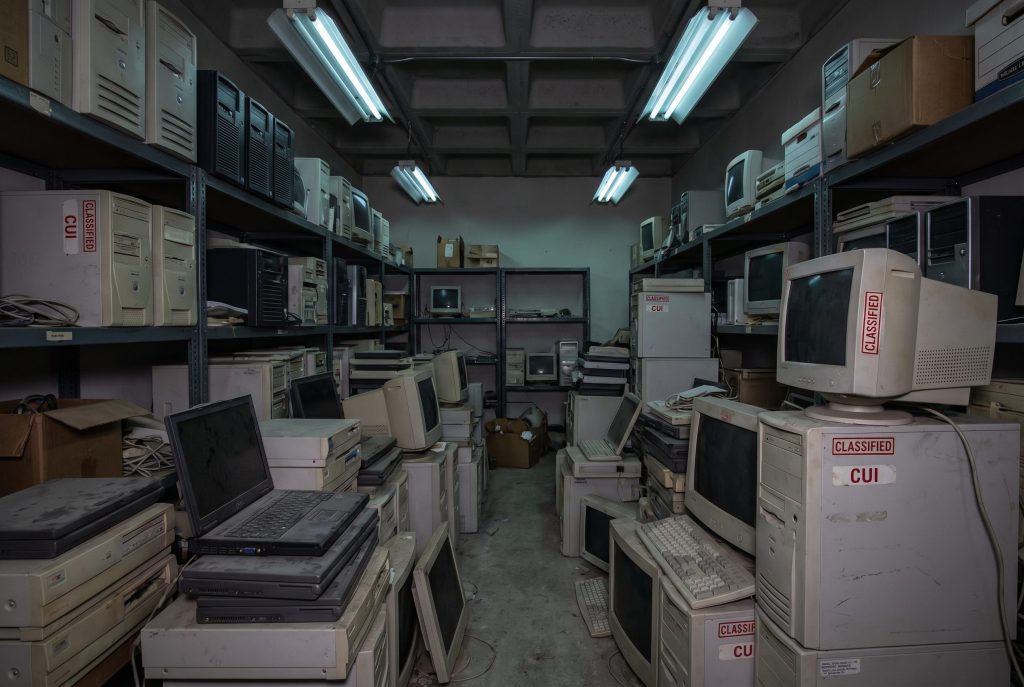
Four patterns appear over and over. The first is stockpiling: retired hardware sitting in offices, closets, or warehouses for months with no access controls and no documentation of what data lives on which device. The second is reliance on factory reset, which leaves data fully recoverable with inexpensive tools anyone can download. The third is improper handling of solid state media.
Standard overwrite procedures do not adequately sanitize SSDs, NVMe drives, or embedded flash, and most businesses are still treating them like magnetic hard drives. The fourth is uncertified vendors. According to Verizon’s 2025 Data Breach Investigations Report, 30% of breaches involved third party access. An ITAD vendor without current R2v3, NAID AAA, and ISO 27001 certifications is a third party risk you are voluntarily introducing into your data supply chain.
How Expensive Is a Breach That Traces Back to Disposed Hardware?
More expensive than any other type, because it is so obviously preventable. When a breach results from a sophisticated nation state attack, there is at least an argument that the company was facing an advanced threat. When a breach traces back to customer records on a laptop that was sold at auction without being wiped, there is no argument. It is negligence, and regulators, judges, and juries treat it accordingly.
Customer PII was the most frequently compromised data type in 2025, appearing in 53% of all breaches studied by IBM, at a cost of $160 per compromised record. Employee PII appeared in 37% of breaches at $168 per record. Intellectual property, though less common at 33%, carried the highest per record cost at $178. A single unwiped drive holding a few thousand records can generate exposure well into six or seven figures before legal fees, notification costs, and reputational damage are even factored in.
What Controls Actually Prevent Breaches at End of Life?
Five controls do the work. First, set a maximum dwell time for retired assets. Once a device comes out of service, it should be queued for sanitization within days, not parked in a closet for an indefinite future. Second, sanitize at the source. The moment a device is decommissioned, wipe it or lock it in secure staging for imminent processing.
The longer data sits on a powered down device in an unsecured area, the larger your exposure window. Third, match sanitization to data sensitivity using NIST SP 800-88 Rev. 2 (Clear, Purge, or Destroy), and use IEEE 2883 compliant methods for solid state media. Fourth, require serial number level chain of custody for every asset from the employee’s desk to final disposition. Fifth, vet your vendors. Require current R2v3, NAID AAA, and ISO 27001 certifications. Ask for asset level certificates of sanitization or destruction, not aggregate reports.
How Do You Choose a Vendor That Actually Reduces Breach Risk?
Treat vendor selection as a security decision, not a procurement decision. Require current R2v3 certification (not the outdated R2:2013), NAID AAA for data destruction, ISO 27001 for information security management, and ISO 14001 for environmental management. Verify every certification independently through the SERI R2 directory and the NAID certified company directory, not just the vendor’s website. Ask where the equipment goes physically.
Ask who handles it at every step. Ask for a sample audit package. Ask whether they can provide witnessed destruction for high sensitivity assets. Ask what happens to remarketed hardware and how they verify sanitization before resale. A vendor that answers all of that clearly and in writing is a partner. A vendor that gets vague is a risk.
So Why Should Your Company Treat Business ITAD as a Core Breach Prevention Control?
Because it is one of the only breach vectors that is entirely within your control. Phishing campaigns, zero day exploits, supply chain attacks, those are real threats, but you cannot eliminate them completely. Improper IT asset disposal is different. The drives are in your building. The data is on your hardware. The decision about how to sanitize, document, and verify destruction is yours to make. Improper IT asset disposal is one of the most preventable breach vectors in the private sector, and with U.S. breaches averaging $10.22 million, the cost of a single ITAD related disclosure dwarfs what a proper program costs to run.
Business data breach prevention at end of life comes down to five things: cap dwell time, sanitize at the source, match method to sensitivity, document at the serial number level, and use vendors with current certifications and verifiable evidence. Do that consistently and you close one of the most avoidable gaps in your security posture. That is the foundation, and everything else builds from there.